




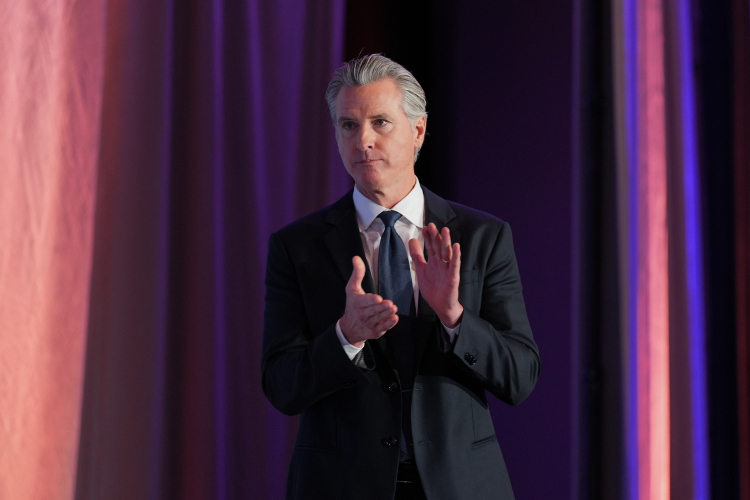
If Gavin Newsom wants to sell himself as a national leader, he should first explain why the country should import the very policies that have made California a cautionary tale.
After years of presiding over one of the highest-taxed and most heavily regulated states in America, Newsom is now calling for a federal wealth tax while promising every American a stake in the wealth created by artificial intelligence.
That is not a bold new vision. It is an economic contradiction dressed up as fairness.
Artificial intelligence is not just another industry. It is the central economic and geopolitical race of the 21st century. The nations that lead in AI will shape productivity, national security, medical discovery, manufacturing, finance, education, and the balance of global power.
The United States leads today because entrepreneurs, investors, engineers, and innovators have been willing to risk enormous sums of capital on technologies that may not produce profits for years.
A wealth tax sends the opposite message. It tells the very people financing the next breakthrough that success will be punished, risk will be taxed, and capital should look for friendlier shores. It makes long-term investment more expensive, weakens capital formation, and invites entrepreneurs to build the next generation of AI in countries that compete aggressively for investment instead of treating it as a political target.
America did not become the world’s innovation leader because government redistributed wealth after the fact. It became the world’s innovation leader because it rewarded people willing to create it in the first place.
California should be the warning label on Newsom’s national agenda.
The numbers are brutal. California’s top marginal income tax rate reaches 13.3 percent, the highest in the nation. The state’s own nonpartisan Legislative Analyst’s Office estimated a $68 billion budget problem for 2024–25, while later analyses put the shortfall as high as $73 billion.
Housing is even more damning: in the second quarter of 2025, only 15 percent of California households could afford the state’s $905,680 median-priced home, requiring an annual income of $232,400.
And Californians keep voting with their feet: the state lost roughly 140,000 residents to net domestic migration in 2023–24 and about 216,000 more in 2024–25. Businesses have noticed too.
A Public Policy Institute of California report found that from 2011 to 2021, 1,250 headquarters left California on net, with annual departures rising from about 240 in 2011 to more than 400 in 2021.
Yet instead of learning from California’s experience, Governor Newsom wants to scale it nationally.
That should alarm anyone who understands what is at stake. The United States is competing against global rivals that view AI dominance as a strategic priority. They are investing in infrastructure, talent, energy, data centers, chips, and advanced manufacturing. America cannot afford to answer that challenge by making itself a less attractive place to invest.
The answer is not to tax ambition. The answer is to make America the best place in the world to build.
That means rewarding investment, expanding research and development incentives, strengthening domestic manufacturing, providing tax certainty, accelerating permitting, developing a skilled workforce, and creating a regulatory environment where entrepreneurs choose America over every other nation.
The greatest threat to American leadership in artificial intelligence is not a lack of talent or imagination.
It is the possibility that misguided public policy convinces investors, founders, and engineers that their next breakthrough is safer, cheaper, and smarter to build somewhere else.
Governor Newsom’s proposal reflects the same philosophy that has weakened California’s competitiveness: tax more, regulate more, spend more, and hope innovation will stay because it always has.
But hope is not an economic strategy.
If America wants to win the AI race, it must remain the world’s most attractive destination for investment, risk-taking, and invention. We should not become the most expensive place on earth to succeed.
