




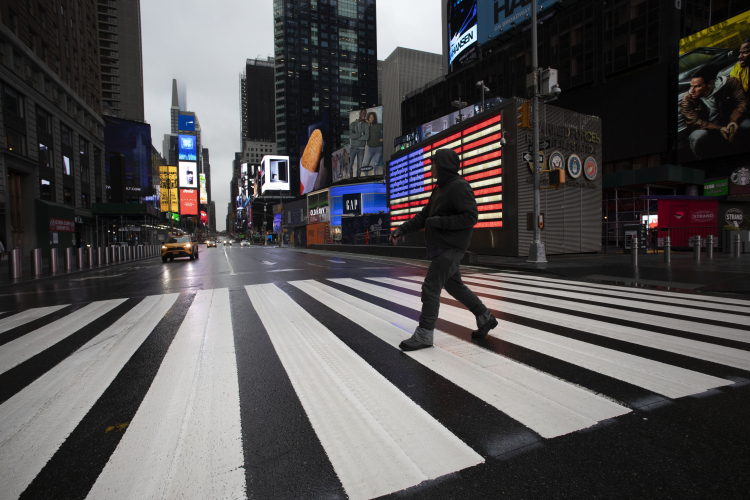
The next time a candidate promises that greater government control will make life safer, fairer and more secure, Americans should remember 2020. They should remember the closed schools, shuttered businesses, restricted churches, isolated families, arbitrary mandates and government checks intended to compensate people for livelihoods government had interrupted.
COVID was not socialism in the strict textbook sense. Government did not nationalize most businesses or formally abolish private property. But the pandemic gave Americans a revealing glimpse of the governing instinct behind socialism: Central authorities replaced millions of individual decisions with government orders, restricted private activity in the name of the collective good and made citizens dependent on public assistance to endure the restrictions government itself imposed.
During the frightening opening weeks, temporary precautions were understandable. We faced an unfamiliar virus, hospitals feared being overwhelmed and officials had limited information. Most Americans accepted extraordinary restrictions because they were told the measures were necessary and temporary.
The problem was how quickly temporary precautions became a system of control and how slowly government surrendered that control.
Officials decided who could work and which businesses were “essential.” They determined whether children could enter their classrooms, congregations could enter their churches and families could visit elderly relatives. Restaurants, gyms, salons, theaters and neighborhood stores were closed or severely restricted. Weddings, funerals, worship services and private gatherings were regulated by executive order.
To a governor or public-health official, a restaurant or gym might have appeared nonessential. To its owner, it was income, retirement savings, personal identity and perhaps a business intended for the next generation. There was nothing nonessential about it.
Private ownership means less when government decides whether the owner may open the doors, employ workers or serve customers. The deed may remain in private hands, but practical control has shifted to the state.
The same pattern reached schools. Parents did not individually decide whether remote instruction was best for their children. Government agencies, teachers unions and school systems made that decision for them. Students and families bore the consequences through lost learning, social isolation and enormous strain on working parents.
Government also intruded on religious worship. Churches, synagogues and mosques were closed or severely restricted, sometimes while liquor stores and large retailers remained open. Americans were told when they could worship, how many could attend and even whether they could sing.
The First Amendment does not say religious liberty applies only when public officials consider it convenient. Yet during COVID, constitutional freedoms were treated as privileges that government could suspend and later restore.
Many rules imposed under the banner of science were actually emergency judgments supported by limited evidence. The six-foot distancing rule reduced business capacity and complicated school reopenings, yet Anthony Fauci later said he could not recall how that exact distance had been selected. It “sort of just appeared.”
Masking policies often showed the same lack of discrimination, treating crowded indoor settings much like solitary outdoor activity. California authorities even pursued and arrested a lone paddleboarder during a beach closure. Such episodes revealed what happens when officials become so certain of their authority that questioning a rule is treated as rejecting science.
Public-health experts were qualified to explain medical risks. They were not uniquely qualified to decide how much education, economic independence, religious liberty and personal freedom should be sacrificed. Those were political and moral decisions that belonged to elected representatives and the public.
Yet “following the science” became a way to avoid that debate. Science could help estimate the risk of infection. It could not decide whether a child should lose a year in the classroom, whether a family business should be destroyed or whether a dying person should be separated from loved ones.
Those decisions required balancing competing risks and values. Instead, one objective, reducing the spread of the virus, was often allowed to overwhelm nearly every other consideration.
The economic response reinforced the same pattern of centralized control.
Government restricted private commerce and prevented millions of people from earning income. It then stepped in with forgivable loans, enhanced unemployment benefits, stimulus checks and other assistance.
Some support was necessary. Government could not prevent people from working and then simply abandon them. But the arrangement exposed the deeper danger: Government first displaced private economic activity and then made citizens and businesses dependent on public money to survive the restrictions it had imposed.
That is the governing instinct behind socialism. Decisions move away from individuals, employers and markets and toward political officials who determine which activities may continue, who qualifies for assistance and how resources will be distributed.
The government that closed the business became the government offering to save it. The government that interrupted the paycheck became the government mailing the check. Dependence was not an accidental side effect of the restrictions. It was their predictable result.
Socialism is commonly sold as a promise of security. Government will protect people from illness, unemployment, high prices, inadequate housing and economic uncertainty. But protection requires authority. The more responsibility citizens surrender to the state, the more power the state claims to direct their choices.
COVID gave Americans a practical demonstration of that bargain. Officials promised safety and claimed the authority to regulate work, education, worship, travel, medical decisions and private gatherings. Every restriction was described as temporary, necessary and imposed for the common good.
That is how centralized control usually advances. It does not arrive by announcing that freedom is being abolished. It arrives through promises of safety, fairness, expertise and temporary necessity. Each expansion appears reasonable when viewed alone. Together, they transfer control of everyday life from citizens to the state.
This was not solely a Democratic failure. Officials in both parties expanded government power during COVID, which is precisely why the danger is larger than any one party or politician.
The lesson is especially important today because democratic socialism is gaining influence within the Democratic Party. The Democratic Socialists of America is not formally the Democratic Party, but its candidates generally seek office through Democratic primaries, and several have defeated incumbent Democrats.
The movement is candid about its objectives. Its constitution calls for “popular control of resources and production” and “economic planning.” Its national endorsement standards expect candidates to identify publicly as socialists, support the organization’s platform and view themselves as socialist organizers first and legislators second.
Americans should take those declarations seriously. COVID showed what centralized direction can look like before government formally owns private property. Officials may leave the deed in an owner’s hands while deciding whether the business may open, whom it may employ and whom it may serve. They may leave churches and schools nominally independent while determining whether people may enter them.
Not every Democrat is a socialist, and not every government program is socialism. But a movement seeking to transfer more economic and personal decisions from individuals, families, businesses and communities to government is no longer operating only at the political margins. It is winning elections and attempting to reshape one of America’s two major parties.
The Constitution was designed because the Founders understood that concentrated power, even when accumulated for supposedly benevolent purposes, threatens liberty. Separation of powers, federalism, property rights, religious freedom and due process are not outdated obstacles preventing government from helping people. They are protections against officials who are certain they know what is best for everyone else.
Liberty is more than the freedom to do what government experts recommend. It includes the right to operate a lawful business, educate one’s children, worship, own property, question authority and accept reasonable risks without first obtaining government permission.
Socialism promises security through collective action and centralized direction. The pandemic revealed the other side of that bargain: A government that assumes responsibility for protecting every part of life will eventually claim the authority to control every part of life.
Today, candidates are again promising that greater government control will make life safer, fairer and more secure. Before accepting that promise, Americans should remember 2020.
They should remember who was permitted to work, which businesses were declared essential, whether children could enter their classrooms, whether congregations could enter their churches and whether families could visit their loved ones.
They should remember how private independence was replaced by government permission and public assistance.
Above all, they should remember the lesson of 2020: Government power surrendered during an emergency is easily expanded, rarely exercised with humility and never returned as quickly as promised. Liberty is safest when citizens refuse to surrender it in the first place.
