




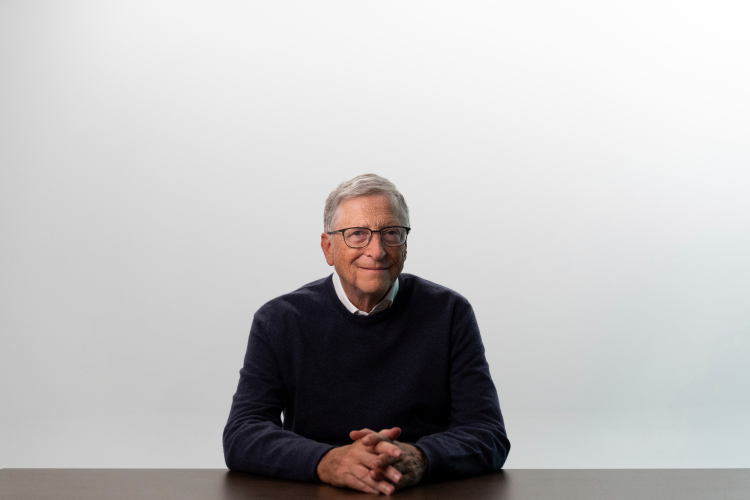
Bill Gates is the latest tech titan to weigh-in with a mini-manifesto on AI. History shows, when it comes to technology, those who “invent the future” generally fail to predict what follows.
Mr. Gates essay epitomizes a growing way of thinking about AI which is that it is so uniquely disruptive and dangerous that it requires heavy-handed government intervention. Let’s consider the problems with such framing.
Bill Gates: “Even under the best circumstances, the transition to this new AI era will be one of the most turbulent times in human history.”
When it comes to turbulent times in all human history, please. Humanity has suffered a sorry litany of wars, disasters, and pestilences – e.g., the bubonic plague killed 20 to 40 percent of the human population. (Covid’s official death toll; 0.1 percent.) Two of history’s most gruesome wars occurred in the 20th century.
If we consider consequential technological disruptions over history, try gunpowder perhaps, or the combustion engine. How about the telegraph? Imagine the shock people felt after thousands of years wherein no communication ever moved faster than the speed of a horse but could now move at the speed of light. Talk about “exponential change.”
Presentism is the term for the inability to truly appreciate, even by reading history, the in-the-moment impacts our ancestors felt.
No one disputes AI is disruptive. It is indeed, as Mr. Gates asserts, an epochal shift. I note with self-interest that AI disruption was a central thread in my book, The Cloud Revolution. Disruptions invariably animate debates about who and what to regulate to achieve the elusive Goldilocks outcome.
“Many jobs will disappear forever.”
“There will be some new jobs, but without the right policies there will be far fewer than exist today.”
“We have to think now about how to reduce job losses so that everyone can share in the prosperity that AI creates.”
“While the move from agriculture to office work took generations, sectors like law, customer service, software and manufacturing will feel AI’s impact over the course of a decade.”
The idea is that the “right policies” will somehow avoid a putative jobs apocalypse engendered by AI labor productivity gains. But labor productivity doesn’t lead to overall mass unemployment. Instead, it changes the nature of and expands the number of jobs. History shows that most kinds of jobs disappear over time. That’s not just normal, but a good thing.
Consider: MIT economics professor David Autor has documented from Census data that some 60 percent of the categories of jobs that existed circa 1950 have since disappeared. We don’t have 60 percent unemployment. Today most people are employed in classes of jobs that never before existed, a trend consistent over history.
Meanwhile, regarding productivity promises, AI has far to go to deliver the kinds of radical labor productivity gains associated with earlier technology revolutions. As I wrote recently in the City Journal:
[B]etween 1910 and 1930, technology drove down labor hours per car manufactured by nearly fourfold, and per ton of steel, by a factor of seven.
The 1960s saw another episode of productivity progress. Automation boosted car production while it lowered employment. President John Kennedy created an Office of Automation and Manpower to tackle what he said was “the major domestic challenge of the Sixties: to maintain full employment at a time when automation, of course, is replacing men.” President Lyndon Johnson followed with a Blue Ribbon commission to study Technology, Automation, and Economic Progress that originated the idea of “a guaranteed minimum income,” repackaged today as a Universal Basic Income (UBI).
“As workers are pushed into different jobs . . . they will be working less, which means they will be paying less in income taxes, and government revenues will drop just when the demand for those services is greatest. The funds will have to come from somewhere at a time when budgets are stretched.”
“I believe we should tax AI tokens and robots. . . . The tax system nudges you toward replacing people with machines.”
History makes clear that it’s technology not taxes that nudges businesses to replace people. That’s the productivity miracle of modern times. Proof of the role of technology-driven productivity as the prime mover of economic flourishing is what earned Robert Solow the 1987 Nobel Prize in Economics and underlies the insights that earned Joel Mokyr a co-award for the 2025 economics Nobel Prize.
Bureaucrats and statists reflexively look to tax policy as a tool to incentivize behaviors. But the primary function of tax is to harvest some portion of the wealth that’s created by productivity. Thus, the best tool government has for finding more tax revenue is to implement policies that maximize economic growth, i.e., focus on unleashing, not constraining, technological advances.
“Set aside some jobs for humans. . . . I believe that as AI and robots improve, we’ll set aside certain things for only people to do. I’ve started calling this domain Human Reserved.”
“The Human Reserved domain will evolve over time—for example, we should consider setting aside some jobs now and phasing in AI slowly over years or decades with a commitment to preserve some jobs. . . The idea of Human Reserved raises a host of questions I don’t have answers to. Who gets to decide what we reserve for humans?” [emphasis in original]
Where to begin? Who gets to pick winners and losers? It stretches credulity to believe that any such decisions could be made both objectively and productively. Even the attempt to do so risks damaging entire economies, never mind lives and businesses.
This idea cuts to the core of the AI disruption debate. Micro-managing society to try to ensure some ideal outcome will lead to far worse outcomes than markets doing the same job, even if imperfectly.
“There is no plan to ease the entry into the AI era.”
“National leaders should convene economists, technologists, labor experts, business leaders, and workers themselves regularly to identify where existing institutions are failing and what new authorities may be needed.”
The phrases, “there is no plan” and “new authorities may be needed,” are dangerous words when applied to national leaders. They remind one of President Reagan’s famous framings of what to fear: “I’m from the government, and I’m here to help.”
Few ideal solutions have ever been concocted by national leaders and experts when it comes to complex society-wide disruptions. Citizens, businesses, and markets regularly face disruptions from malfeasance, misgovernance, nature, and technological change. The key to weathering these vicissitudes is found in resilience, which is itself anchored in sufficient wealth. Wealthier societies tolerate and adapt to disruptions far more easily. Governments have a critical role in ensuring that general regulations, laws, and taxes, are bent toward allowing citizens, businesses, and markets to operate with the maximum possible freedom to generate wealth and thus resilience.
“This is why an international organization will need to be built . . . it can follow the model of some existing systems. There’s an inspections regime for nuclear weapons, regulations for international aviation, and agreements that protect the ozone layer. A new global organization for AI will need elements of all three and more.”
“It is fair to wonder whether the world’s institutions are up to the task of designing and implementing this new architecture. . . . Some cooperation between the U.S. and China will be required.”
Mr. Gates is hardly alone in invoking the need for a wise global organization to manage humanity’s propensity to disrupt, and there is a long list of such ignominious attempts. While there have been some successes in international collaborations, they tend to be narrow and specific, or sufficiently vague to be mainly aspirational; e.g. standards of communication and safety for a particular transportation system, agreeing to limit using a specific chemical, or vague agreements involving specific weapons (nuclear, chemical) and setting up monitoring regimes (unenforceable, often ignored).
As for pinning hopes on regulatory cooperation with China? It is indeed “fair to wonder.”
“This time really is different.”
He’s right. There is always something different about every technological revolution. But the embedded idea is that AI’s features and impacts on industries and people really are somehow profoundly different in reach and velocity. So far though, no AI tool has come within tenfold of matching the kind of industry-wide productivity gains—i.e., labor reductions—witnessed in the tumultuous technological revolutions at the turn of the 19th to 20th century. Not even close. It could happen; we should hope it does in fact. The last few decades have seen a productivity growth slowdown.
Technologically brilliant, savvy, and accomplished individuals such as Mr. Gates have spotty records (to put it kindly) when it comes to predicting the future, especially future disasters. Physics Nobelist Dennis Gabor, for example, introduced his 1960 book "Inventing the Future" by summarizing what many experts of that day called “the trilemma” in their immediate future, i.e., overpopulation that would in their lifetimes to economic collapse and global war; the inevitability of a nuclear war; and the inevitability of automation causing massive and permanent unemployment.
There is indeed something different about AI technology. But Mr. Gates, and most others, miss what that is. More on that later.
