




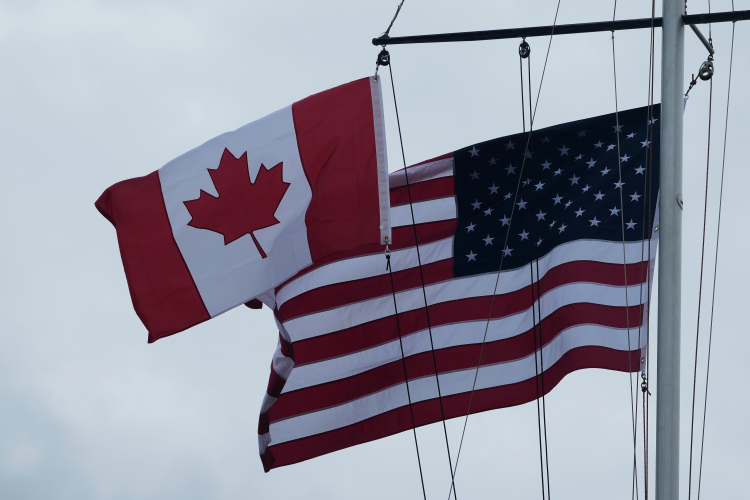
On August 22, the United States imposed tariffs of 50 percent on C$28 billion ($20 billion) of Canadian goods after trade talks collapsed. Mark Carney, Canada’s prime minister, ordered his negotiators home the night before, saying that last-minute changes to America’s terms “called into question the reliability of any deal.” American officials say that Canada walked back commitments reached earlier in the week. Some speculate that Howard Lutnick’s arrival to the talks changed the dynamics.
The details matter, but only to an extent. Each side will tell their own story about who moved the goalposts, who was being unreasonable, and why they offered the other side the best deal in town. What matters more is that two countries who, for generations, have been on arguably the friendliest of terms now believe the other one can no longer be counted on to keep the goalposts in place.
Three days later, Canada announced retaliatory tariffs of up to 50 percent on roughly 700 American products. Canadian officials have stated plainly, in both English and French, that the targets had been chosen to pressure specific American states ahead of November’s midterm election. That retaliation will hurt Canadians, too. Tariffs do not become wise economic policy just because Ottawa is imposing them instead of Washington. But the broader message here is that Canada is no longer treating access to the American market as the organizing theme of its economic strategy. After 18 months, it’s clear that Prime Minister Mark Carney is right: “America has changed, and we will not return to our old relationship.”
That sentence is worrying. Canada cannot replace the U.S. overnight. Geography, integrated supply chains, decades of business relationships, and the simple fact that Detroit is closer to Windsor than it is to most of America all still matter. The United States will remain Canada’s most important trading partner for the foreseeable future and Canada will remain ours, too.
But leverage is not measured by how large your market is. It’s measured by the other party’s next-best alternative. Every time Canada, Europe, Japan, or Britain signs a new trade agreement, that next-best option improves and lowers the cost of saying no to Washington.
This is what tariff strategists and their defenders keep missing. Tariffs can work as a negotiating tool only if two conditions are met. First, the other country must have something it can do to make the tariffs go away. Second, they must not have viable alternatives. If the rules and justifications for tariffs keep changing, if the list of demands keeps expanding and shifting, and if compliance today does not mean predictability going forward, the only rational response is diversification.
And that is exactly what the G7 have been doing.
But while Washington was raising tariff rates on friends and foes, the rest of the G7 has been busy signing new agreements around the world. In January, the European Union concluded its agreement with Mercosur, linking 700 million consumers and saving European firms €4 billion ($4.7 billion) per year in duties once it is fully in force. Shortly thereafter, the EU finished a free-trade agreement with India, which will cut Indian tariffs on 96.6 percent of EU exports. And in March, the EU completed another deal with Australia and signed a security and defense partnership on top.
The United Kingdom is doing the same. Their trade agreement with India allows some 90 percent of UK goods to enter India duty-free or face reduced tariffs. Indian duties on Scotch whisky dropped from 150 percent to 75 percent immediately and eventually to 40 percent. Tariffs on British cars fell from 100 percent to 10 percent. In May, the UK reached a free trade agreement with all six Gulf Cooperation Council states. That deal still requires ratification, but the pattern is clear: Britain is looking outward while America is busy building walls.
Japan is hedging, too. America is their top export market, but uncertain tariffs justified under constantly changing legal authorities have made the US market less certain. It’s not hard to understand why they would want diversification for themselves. To that end, they have opened negotiations with Mercosur in May after seeing the deal with the European Union concluded.
Then, there’s the Comprehensive and Progressive Agreement for Trans-Pacific Partnership (CPTPP), the successor to the Trans-Pacific Partnership that Washington helped assemble and then abandoned. Today, their twelve members account for 14.4 percent of world GDP and several more countries are in the process of joining. This Agreement eliminates 99 percent of tariff lines among its members.
In March, the CPTPP and the EU issued a joint proposal for reforming the World Trade Organization. In it, they called for rules-based trade, cooperation among like-minded members, and progress on plurilateral negotiations. The United States, which helped create the postwar trading system to begin with, was not a part of these discussions.
Canada has done more than just complain. They have been actively insuring against American unreliability. In early 2025, its then trade minister, Mary Ng, said that her office was focused on signing new trade deals. Since then, Canada has signed deals with Indonesia and Ecuador, struck a tariff-easing deal with China and is currently negotiating deals with Mercosur, India, and the ASEAN bloc. Canada now views diversification as national strategy. In Prime Minister Carney’s speech, he said that Canada had signed “more than 20 trade and security deals across five continents” and that Canadian business enjoyed tariff-free access to 1.5 billion consumers, with the goal being to double that number through deals with ASEAN and India.
But the most striking example isn’t even a trade agreement per se. Canada became the first non-European country to be admitted to SAFE, which is a €150 billion ($174.7 billion) joint defense-procurement program. Defense supply chains are not the same as normal supply chains. Countries integrate militarily when they feel they can trust their partners. And now, Canada is building that trust with Europe as a hedge against relying on the US.
Prior to 2025, Canadian officials had talked about supplementing their trade with America. Now, it seems they’re looking to supplant it.
France, Germany, and Italy all move as the EU moves. Britain signs its own deals thanks to Brexit. Japan is looking for alternatives. Canada is diversifying and rapidly so. Meanwhile, the United States raises tariffs on allies, changes the legal justification as needed, and then demands gratitude for temporary exemptions, pauses, or extensions from penalties they imposed in the first place. According to James Bacchus, a former chairman of the WTO’s appellate body, since the USMCA took effect in 2020, nearly 70 trade agreements have entered into effect around the world. The US is involved in none of them.
Looking at tariff schedules around the world reveals much the same story. America’s average tariff rate was about 2.4 percent prior to 2025. Today, according to the Yale Budget Lab, it sits around 11 percent. Meanwhile, the EU has abolished its remaining tariffs on U.S. industrial goods while the US charges Europe a baseline 15 percent tariff. British tariffs with India fell as their trade agreement took effect. Canada has raised tariffs against exactly one country in the world while cutting tariffs elsewhere, including reducing its tariff on Chinese electric vehicles from 100 percent to 6.1 percent. China has reduced barriers against Canadian canola and other agricultural exports. And while it is true that Canada and Europe have raised tariffs on steel, most of this is meant as a safeguard against steel diverted from the US market. The broader pattern within the G7, however, is that tariffs are rising when the US is involved and falling when it is not.
This is the fatal conceit in Washington’s approach to using tariffs as a negotiating tactic. They work best when the other country has nowhere else to turn to and have a clear objective that would result in their elimination. Every agreement that Canada and the rest of the world signs lowers the price of saying no to Washington.
None of this means that America is irrelevant to Canada and it certainly doesn’t mean that Canada’s retaliatory tariffs against the U.S. are economically wise. The U.S. and Canada will continue to trade with one another because of geography and culture and the tariffs that Canada is imposing on the U.S. will make Canadians poorer just as Washington’s tariffs are making us poorer. But these past 18 months were supposed to demonstrate the leverage that access to the American markets gave us in international trade. Instead, what they’ve shown is the value of finding new trading partners that are more predictable and whose agreements aren’t written in pencil.
