




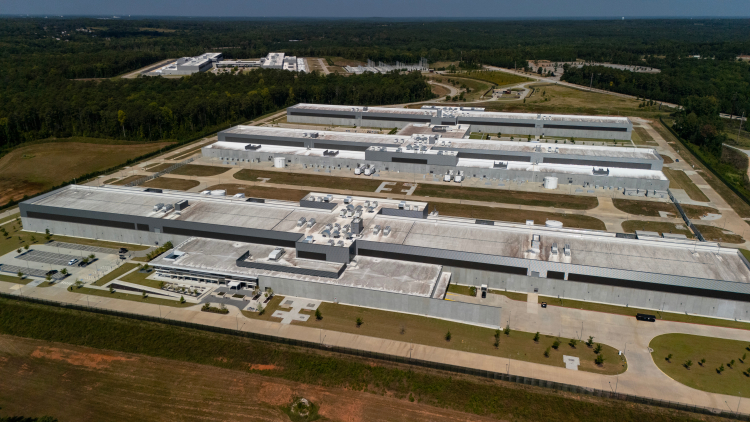
Every transformative period in American history has required new physical infrastructure.
The Industrial Revolution required railroads, factories and electric power. The automobile required highways. Commercial aviation required airports. The internet required fiber-optic networks and cellular towers.
Artificial intelligence requires data centers.
Yet politicians in both parties are suddenly campaigning against them. Some want moratoriums. Others warn that data centers will drain lakes, pave over farms and raise electric bills. Instead of explaining how America can build this infrastructure responsibly, they have discovered that frightening voters is easier.
The political reversals have been remarkable.
Illinois Gov. J.B. Pritzker once courted data centers but has become increasingly critical of them. Pennsylvania Gov. Josh Shapiro celebrated major data-center investment before imposing new restrictions on development. Texas Gov. Greg Abbott promoted his state as a center of artificial intelligence before pausing new construction. In Wisconsin, Republican gubernatorial candidate Tom Tiffany has made opposition to data centers a centerpiece of his campaign.
There may be legitimate reasons to reconsider individual projects. Conditions change, and public officials should respond when new facts emerge. But when politicians from both parties discover the same objections just as voters become anxious and elections approach, skepticism is warranted.
These are the political descendants of people who would have opposed railroads because trains were noisy, airports because airplanes disturbed nearby neighborhoods and highways because they changed the landscape.
Every one of those projects imposed costs. Each also helped create the prosperity Americans now take for granted.
A railroad could divide a farm. An airport could fill surrounding neighborhoods with noise. A highway could displace homes and businesses. Yet previous generations understood that the answer was to manage those costs, not refuse to build the infrastructure upon which the nation’s future depended.
Data centers are comparatively quiet. They generate little pollution at the site itself, particularly when compared with airports, steel mills and other traditional industrial facilities. Their environmental footprint depends largely upon how their electricity is generated and how their cooling systems are designed.
They are not merely large, windowless buildings occupied by wealthy technology companies. They are the physical foundation of the digital economy and increasingly of artificial intelligence.
As the Wall Street Journal recently observed, “The surge of opposition to data centers reflects misinformation and anxiety about the future more than it does reality.”
America already has more than 5,400 data centers. They support online banking, video conferences, hospital systems, financial markets, streaming services, retail inventories and nearly every application on our phones. If they stopped operating, much of the modern economy would stop with them.
The newest data centers will do much more. They will provide the computing power that allows manufacturers to operate more efficiently, utilities to predict equipment failures, scientists to develop new medicines and physicians to detect diseases earlier. They will support AI systems that help small businesses perform work that once required enormous corporate departments.
If the United States wants the productivity, wage growth and scientific advances that artificial intelligence can produce, it must build the infrastructure that makes them possible.
That does not mean every proposed data center belongs in every community. Electricity demand, water consumption, transmission capacity, land use and environmental effects are legitimate considerations. Developers should pay for the additional infrastructure their projects require rather than shifting those expenses onto existing homeowners and businesses.
But there is an enormous difference between planning intelligently and refusing to build.
Not every part of the country is equally suited for large data centers. Markets should determine where they are built, with climate, electricity costs, transmission capacity, water availability and land prices guiding investment.
The Great Lakes region is an obvious place to look.
Data centers generate heat every hour of every day. Northern temperatures can reduce cooling demands during significant portions of the year. The cold water of the Great Lakes may also offer cooling possibilities through carefully designed heat exchangers and closed-loop systems that protect water quality and minimize consumption.
The Great Lakes region also has substantial nuclear and hydroelectric generation, high-voltage transmission infrastructure, fiber networks, industrial land and generations of engineering and manufacturing experience.
Communities such as Rochester, N.Y., illustrate the possibilities. Rochester has a cool climate, access to Lake Ontario, nearby nuclear generation, Niagara hydroelectric power to the west and major high-voltage transmission facilities.
But this is not merely a Rochester opportunity. Similar combinations of climate, water, power, transmission, industrial property and skilled workers exist across the Great Lakes corridor.
Many of these communities already possess the land, utilities, transportation networks and engineering experience that supported earlier generations of American industry. Assets that seemed less important as manufacturing declined could become newly valuable in the AI economy.
If developers must bear the costs they impose rather than shifting them to existing customers, naturally advantageous regions such as the Great Lakes will become more attractive. Prices and competition can direct these investments more effectively than politicians can.
The larger opportunity also extends beyond the buildings themselves.
Data centers require electrical engineers, cooling specialists, construction companies, fiber networks, cybersecurity systems, substations, backup generation, energy storage, advanced controls and continuous maintenance. Their presence can help support a larger industrial and technological ecosystem.
They also provide substantial property-tax revenue.
The Journal points to Loudoun County, Va., where one analysis concluded that homeowners would pay approximately $5,800 more each year in property taxes if data-center revenue disappeared and government services remained unchanged. In Louisiana’s Richland Parish, data-center tax revenue helped provide some teachers with bonuses reaching $50,000.
Those are not imaginary benefits.
Data centers will not solve every economic problem. Once construction is completed, they generally employ fewer people than traditional manufacturing plants. Political leaders should be honest about that. But employment inside the building is only one measure of value. Data centers provide the computing infrastructure upon which thousands of other businesses, researchers and institutions will increasingly depend.
We cannot demand the benefits of artificial intelligence while refusing to build the machinery that makes them possible.
AI may appear on a computer screen, but the infrastructure supporting it is made of concrete, steel, electrical transmission, cooling systems, computer chips and enormous amounts of dependable power. Leadership in artificial intelligence will require more than algorithms, speeches and government reports. It will require building things.
Basic rules should ensure that existing utility customers are not forced to subsidize large new users. Developers should bear the costs they impose, and communities should be free to negotiate tangible local benefits. Beyond that, investors and markets should determine where these facilities make economic sense.
A national moratorium, or a political movement built upon fear, would be an act of economic self-sabotage.
The countries that built railroads, electrical grids, highways and airports became the economic powers of their eras. The countries that build the computing and energy infrastructure required for artificial intelligence will lead the next one.
The next election may be only months away. The consequences of failing to build this infrastructure could last for generations.
America needs political leaders capable of thinking beyond both.
