




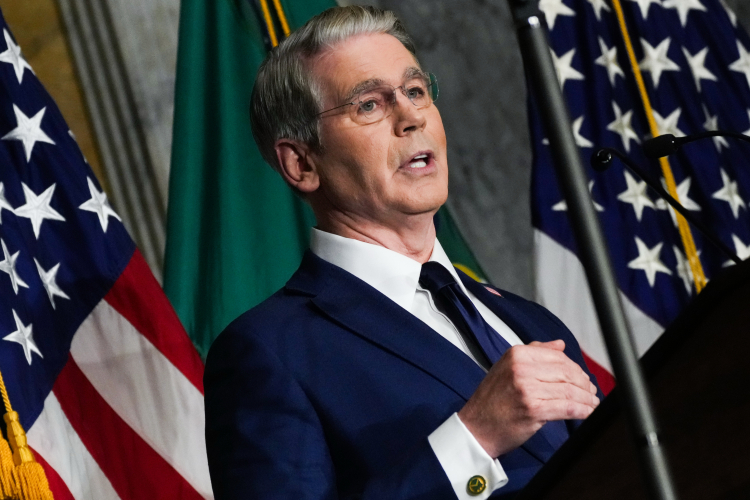
Earlier this month, the United States hosted a meeting of G20 Finance Ministers and Central Bank Governors in Asheville, North Carolina. Hundreds of journalistic outlets across America celebrated this important event by ignoring it entirely, while those that did mention it did so only to report on the controversial presence of the Russian finance minister. In the event, the Trump Administration used the occasion to push an agenda of economic deregulation, greater private-sector investment, reduced external imbalances, and myriad other policies. Cynics may sniff that the Administration, which has promoted unprecedented intrusions into private enterprise and trade-strangling tariff hikes, should practice what it preaches. And the best guide to what the Administration should be practicing may be the so-called Washington Consensus, advocated in Washington in the 1990s to guide developing countries toward faster development and growth.
Some 37 years ago, John Williamson coined the phrase “the Washington Consensus” to refer to a set of reforms needed to get Latin America back on track for sustainable growth after the debt crises of the 1980s. The reforms covered 10 areas, among them fiscal discipline to keep budget deficits low, reallocation of public spending towards activities that improve growth and reduce inequality, market-determined interest rates, a competitive exchange rate, trade liberalization, liberalization of inward foreign investment, and secure property rights. While originally developed with Latin America in mind, the main elements of the consensus were seen by many (but not all) economists as relevant and applicable to many Emerging Market and Developing Countries (EMDEs). And these market-friendly, pro-growth reforms were not just supported by the IMF and the World Bank – they were a key focus of the U.S. government’s strategy for engaging with the developing economies.
While progress has been uneven, there is no doubt that EMDEs have made considerable strides in implementing the recommendations of the Washington Consensus. Many of these economies have strengthened central bank independence (reducing pressure to finance fiscal deficits) and adopted best-practice monetary policies such as inflation targeting, leading average inflation to halve from 9 percent in 2000 to just to 5 percent in 2025, despite spikes in oil and other commodity prices, with the IMF projecting further declines until 2031. EMDEs have adopted more flexible exchange rates, opened their economies to trade and foreign investment, and reduced the role of government in their economies. As in the advanced economies, EMDEs struggle to get their fiscal deficits under control and these have risen since the onset of the pandemic, but they are expected to narrow somewhat over the rest of the decade. Debt-to-GDP ratios for EMDEs as a whole are projected to rise, but that mainly reflects rising Chinese government debt, while in Latin America, the Middle East and Central Asia, and Sub-Saharan Africa, debt to GDP ratios are expected to remain broadly constant.
Reflecting the increased resilience stemming from reforms, economic growth in the developing countries has averaged a still-solid 4 ½ percent since 2022, despite disruptions to global trade and aid, and is expected to average around 4 percent per annum until 2031. Financial markets have taken due notice of the improvements in policy frameworks. Since the tightening cycle of U.S. monetary policy that began in 2022 started to ease, interest rate spreads on emerging market corporate debt have declined and are very low relative to historical averages (Figure 1).
Figure 1. Emerging Markets Credit Spreads and U.S. Treasury Yields

While the EMDEs struggle to meet the recommendations of the Washington Consensus, the Trump Administration is working equally hard to distance itself from those principles. Instead of liberalizing trade, it has hiked tariffs and other trade barriers. Instead of reducing the government’s involvement in the private economy, it has taken equity stakes in major companies. Instead of allowing the free market to guide energy investments, it has undercut wind and solar power projects while promoting fossil fuel projects that even the energy companies reject. And instead of reducing budget deficits, it has cut taxes and put the federal debt on a path that will rise from about 100 percent of GDP at present to 175 percent by the middle of the century (Figure 2).
Figure 2. Congressional Budget Office Projection of the Federal Debt

Financial markets have finally woken up and smelled the coffee, and long-term interest rates have soared in consequence. Rather than put its own house in order, the Treasury has tried tinkering at the margins with debt buybacks to reduce interest rates, which has little prospect for success in light of the US’s massive borrowing needs in the coming few years. The Treasury’s machinations remind long-time observers of Argentina’s historical obsession with doing everything to finance its deficits and control inflation except to actually cut spending and raise revenues. Ironically, the Argentine government is now slashing its budget, decontrolling the economy, and pushing inflation down to its lowest level this decade. Meanwhile, the U.S. government is busy emulating the policies of the developing economies it so readily criticized back in the 1990s. Clearly, Washington needs the Washington Consensus.
