

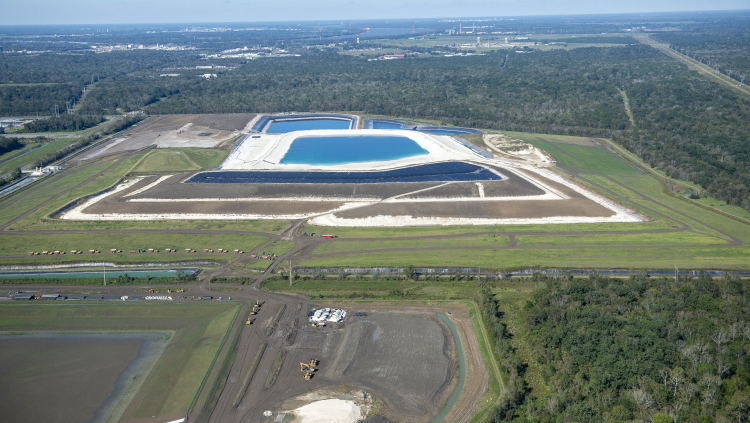
Phosphate fertilizer plants are idling around the world while ships carrying sulfur face delays around the Strait of Hormuz. Sulfur’s soaring price has turned one of agriculture’s basic inputs into a loss-maker, tightening supplies of the fertilizer American farmers depend on.
Today’s fertilizer debate increasingly treats several distinct policy questions as though they were one. The sulfur shortage is largely a supply chain problem. Duties address unfair subsidies. In the face of state-subsidized companies in China and Russia, long-term fertilizer resilience is a national and food security challenge. While these issues are closely related, each requires different assessments and policy solutions.
Phosphate fertilizer production—the monoammonium phosphate (MAP) and diammonium phosphate (DAP) used to grow corn, wheat, and soybeans—requires sulfur-derived sulfuric acid. Roughly 0.4 metric tons, or about 880 pounds, of sulfur are required to produce one metric ton of phosphate fertilizer, where it is converted into sulfuric acid that unlocks phosphate rock. According to industry reporting, sulfur that historically sold for $100 to $300 per metric ton now at times can exceed $1,200.
Sulfur is not mined in significant quantities; it is recovered primarily during oil refining and natural gas processing. The Persian Gulf supplies roughly half of the world’s traded sulfur, much of it through the Strait of Hormuz, where the Iranian conflict has disrupted shipments. Russia, another major producer, faces wartime disruptions and export constraints. In recent months, the Chinese government restricted exports of MAP and DAP and tightened controls over sulfuric acid exports.
As sulfur prices rise, phosphate production becomes uneconomic for some producers, forcing them to curtail or idle production, which tightens global supplies further. Industry estimates suggest phosphate fertilizer shipments were approximately 20 percent lower YoY.
Fertilizer thus sits at the intersection of three distinct U.S. policy objectives: food security, national security, and fair competition. Food security means ensuring reliable access to sufficient and affordable food. National security is broader: it concerns a country’s ability to withstand external shocks and avoid excessive dependence on vulnerable supply chains for critical inputs. A country may have enough food today while remaining strategically exposed if it depends on unstable suppliers for the fertilizer needed to grow tomorrow’s crops. Fair competition addresses a different question: whether foreign producers benefit from government support that allows them to compete on terms market forces alone would not produce. These objectives overlap, but they are not interchangeable.
China has shown its willingness to restrict exports of critical materials when domestic- or foreign policy- priorities require it, while Russia remains an uncertain supplier because of war, sanctions, and export constraints. Russia and India also maintain export bans on sulfuric acid. U.S. companies should not be sending raw materials such as sulfur to countries like China who are unwilling to send back finished fertilizer products.
Resilience, therefore, should not be understood as necessarily reducing or eliminating imports. Rather, it means ensuring that the loss of any single supplier—whether because of war, geopolitical tensions, export controls, or market concentration—does not jeopardize access to critical inputs. That objective requires a broader strategy than deciding whether a particular trade remedy should remain in place.
This shifts attention back to sulfur itself. Because sulfur is recovered primarily during oil refining and natural gas processing, countries with large energy-processing industries also tend to produce the largest quantities of sulfur. Fertilizer security and energy security are more closely connected than is sometimes recognized. Likewise, permitting timelines for new phosphate mines and processing facilities influence how quickly domestic production can respond when global markets tighten.
The domestic base is stronger than commonly assumed, but exports limit domestic availability and could put food security at risk. The U.S. already produces almost all the sulfur it needs, although exports means it now has roughly 75 percent of its needs. Given market segmentation, logistics, and product specifications, it can sometimes be necessary to both export and import sulfur, so solutions need not simplistically rely on export restrictions; rather, than can include stockpiling, supply from reliable partners, and adequate domestic production.
Two conclusions follow. First, sufficient sulfur should remain available to American producers in line with food security needs. Second, expanding U.S. oil refining and natural gas production would sustain the sulfur byproduct stream and strengthen the energy foundation on which fertilizer security ultimately rests.
Even if diplomacy eventually restores normal shipping through the Strait of Hormuz, sulfur markets are unlikely to normalize quickly. Building resilience requires preserving competitive domestic production, ensuring stockpiles are adequate, and ensuring supply from reliable and geographically diversified partners.