

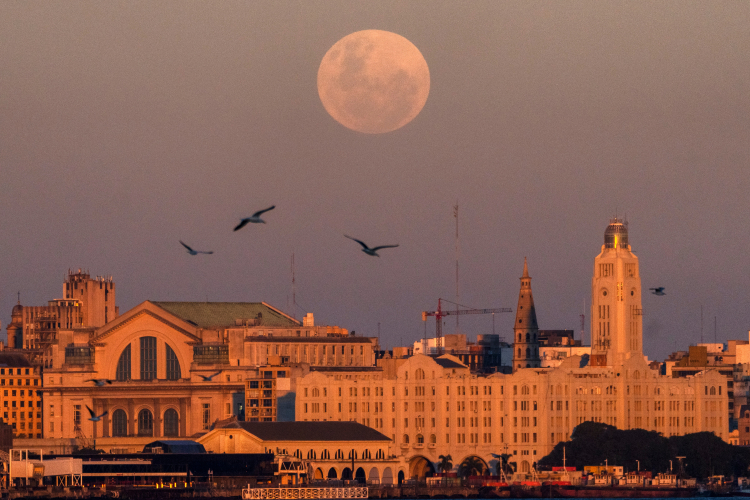
I recently visited Uruguay. It’s full of surprises. It’s the richest state in Latin America, without any - even superficially - held religious beliefs, in a Catholic-dominated continent.
There is no Christmas. In Uruguay, Christmas is called “Family Day.” There is no Easter either – the dates are called “Tourist Week.”
Even though the population was no longer practicing, the Constitution of 1917 separated Church and State officially, removing Catholicism as state religion. Though religious education was already eliminated from schools in 1909.
This was just the culmination of events going back centuries, when in 1767, King Charles III of Spain, expelled the Jesuits. Although other Catholic orders took over their properties, these orders disappeared too, as the indigenous population was tiny and nomad, leaving nobody to convert.
Over the next century and half, French immigrants brought with them the French model of laïcité (secular public life). Church attendance was subsequently minimal, with most of the population now identifying as non-religious or secular.
In 1907 Uruguay introduced no-fault divorce, which the U.S. did only in the 1960s. In 1932 women's suffrage was formally signed into law, times when many European countries did too – though Switzerland signed for it in 1971 only (and some cantons only in 1991). Abortion was decriminalized in 2012, and elective abortion allowed within the first 12 weeks of pregnancy.
Prostitution has been a regulated trade since 2002, though it was not illegal before, and the prostitutes are unionized. In one small town (Colonia del Sacramento, a UNESCO Heritage), the street where this trade was practiced is called “Avenue des Soupirs,” meaning “Avenue of Sighs.” Locals inform that this did not reflect suffering, but noises emanating from the establishments, fake and real. In 2013, Uruguay was the first country in the world to legalize and regulate the production, sale, and consumption of cannabis.
Perhaps even more surprising is that Uruguay consistently ranks as the least corrupt and most transparent country in Latin America, scoring second in the entire Western Hemisphere behind only Canada. Lacking natural resources, this may not be much of a surprise. As was true with pre-1999 Hong-Kong, there were not much “rents” to redistribute and bribe constituents with. Wealth had to first be created before being redistributed.
It helps that there are strict anti-corruption laws, and severe restrictions on public employees accepting commercial or service contracts from the government for themselves or their family members. Also, they cannot “double dip”: even when they retire. Also, when they retire they have a cool-off period during which restrictions apply.
If the public employee participated in designing, drafting, or advising on the bidding for government contracts while still employed, they are strictly prohibited from bidding on that specific contract as a private citizen. This stops employees from drafting contract or regulations to fit post-retirement businesses, and whose wording they would have advantage misusing.
Laws strictly prohibit receiving two incomes simultaneously from the state treasury. If the contract requires a direct personal service paid by public funds, retirees may face a cap or be required to temporarily suspend their public pension payouts for the duration of the contract.
As for voting, the country strictly enforces in-person voting. There are no mail-in ballots, no absentee voting, nor voting from overseas from embassies or consulates. A referendum about letting Uruguayans living abroad vote by mail, failed. There are penalties for not showing up for votes, the amount depending on the type of election, but ranging between U.S. $45 to $95. Even those abroad must vote – or pay the penalty.
Professionals and university graduates pay the higher fees. Citizens who do not are barred from performing several public and civil procedures, such as collecting salaries, public benefits, or obtaining specific documentation. Considering the extremely low participation in municipal votes in the U.S., and the vote-by-mail controversies, perhaps adopting versions of these laws may not be a bad idea.
Last, but not least: taxes. Whereas locals’ income taxes go from 0% to 36%, taxes on capital gains, rental income, interest are a flat 12%. The tax rates are a lure for foreigners.
Corporate taxes are a flat 25% - except when they are not, such as in so-called “Free -Trade Zones,” or on companies trading in goods and services that never enter Uruguayan territory, where they pay 0.75%. Perhaps not surprising, Peter Thiel bought property in Punta del Este (the so-called Miami of South America) in addition to property in Buenos Aires, and Google is building a data center near the capital, Montevideo.
All the above sounds fine, but Uruguay most certainly faces problems: It has one of the highest suicide rates in Latin America, and its fertility rate is at 1.2. To attract new citizens, it offers tax holidays extending to 15 years, and no inheritance taxes. However, I doubt whether taxes alone can remedy the demographic deficit, attracting enough people. The solution may be elsewhere.
It turns out that public schools operate on a four-hour schedule per day, and that includes few hours of sports per week too. The country is as soccer crazy as its neighbor, Argentina. The schools run two shifts – either 4 hours in the morning, or in the afternoon. Only 15% of schools offer a longer schedule, and that includes private schools whose tuition few can afford. How does the government expect both parents to have full-time jobs with this constraint, and have more than one kid?
The absence of extended family may well be linked to the high rate of suicide, as it is older, isolated, bored – disproportionately men - who are behind these suicide statistics. It is not poverty that drives them, as the country has the lowest rate of poverty among the elderly on the continent. The retired, childless aunts and uncles prefer travelling and an easy life, rather than helping with kids not their own, or offering support to isolated elderly in the family.
Happy society? Perhaps. But then without children on the horizon, such “happy” people stop having a history.