

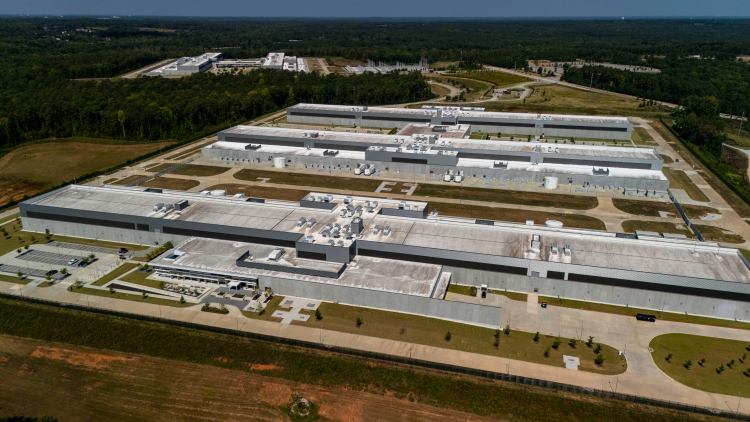
Data centers will do more to enhance global peace than any weapon, treaty, or statesman could ever hope to. A walk of even a tiny portion of one would confirm the previous truth to even the most hardened of skeptics.
Take Wall Street Journal columnist Peggy Noonan. Her optimism about Artificial Intelligence (AI) is tempered by deep pessimism. As she’s written, AI will “cure cancer and blow up the world.” A tour of a data center might cause Noonan to rethink her pessimism. But we’re getting ahead of ourselves.
Leonard Read (1898-1983) famously observed that no man possessed the combined knowledge, skills and resources to make something prosaic as the pencil. As with all market goods, the pencil is an effect of impressively coordinated production all over the world. Which is precisely the point.
With the creation of every market good, so is created an expanded barrier to global conflict. As production is divided across a growing number of hands and machines around the world, the world’s inhabitants have a rooting interest in the economic health of individuals the world over. Nobel Laureate Robert Mundell (1932-2021) wisely asserted that “the only closed economy is the world economy,” and the production of market goods vivifies this truth.
Consider the Boeing 747. It turns out the dearly departed plane was an effect of six million different parts manufactured around the world. Yet even the previous number doesn’t do justice to the global qualities of arguably the world’s most revered passenger plane. Think about it.
While six million globally produced parts once again made up the 747, stop and contemplate the global symmetry required to produce those parts. As with the pencil, no one person has the skills, knowledge and resources to individually produce the six million inputs, which means the 747 is actually the end result of even more diversified global production without which the parts for the 747 either wouldn’t exist, would be too expensive to produce, or both.
Which brings us to data centers. The biggest ones in the world quite literally span over 10 million square feet. The size of them exposes the folly of touring one. They’re just too big to reasonably take the measure of in an hour, a day, or week.
Of course, that’s what makes their production so bullish for world peace. See the 747 once more, but also the pencil. Again, both are an effect of wildly sophisticated global cooperation, only for the typical data center to render the inputs required for the pencil and 747 positively tiny by comparison.
The expectation is that something on the order of $7 trillion will be spent around the world on the creation of data centers by 2030, which means the globalized economic ties that bind the world will grow exponentially in the coming years. If it takes a village to raise a child, it takes billions of specialized hands around the world to build a data center.
Which is why Peggy Noonan could perhaps be made optimistic by a tour of one of these modern monuments to global cooperation. It’s not just that trillions in investment call into the question the notion that the outlays are meant to seed the world’s eventual destruction, it’s that a world this economically connected by the production of data centers would be rendered too peaceful by their creation to destroy what enriches it.