

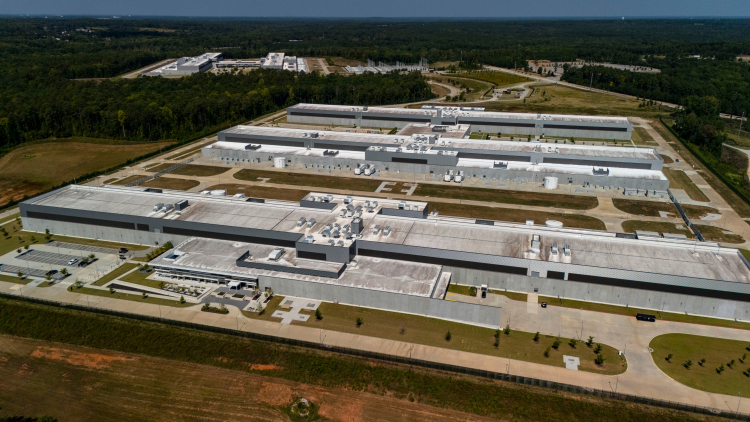
The noise of government regulations breaking the quiet order is erupting around data centers.
An economy that flows according to its natural order does not sharpen the blade of self-righteousness. When a situation arises in which the scale of an economy becomes bloated and its room to maneuver narrows, it gradually comes to need outside assistance. At some moment, this helping hand comes as pressure. At the center of it, power takes its seat. Even if it does not reach a planned economy, circumstances appear in which the economy moves according to the logic of power.
The present situation, in which the flow and scale of the economy are tilting to one side, is stimulating the emergence of regulation. The rapid growth of AI is creating a new milestone for the global economy. Companies that generate enormous profits are being born, and with this capital they are preparing a foothold for continued growth. The immediate task of AI-related companies, building the Base, is the establishment of data centers. Sharp conflict is emerging over this issue.
The AI industry’s strong appeal is that, in order to keep drawing profits in the future, the construction of these data centers must be firmly established. Along with this, opposing voices are also picking up speed more fiercely. The gist of the counterargument is that if the push is made recklessly without a clear assurance that the invested funds will be recovered, surrounding industries may also suffer negative effects together.
We need to look at how the rapid expansion of AI investment is actually unfolding. According to the IEA’s 2026 report Key Questions on Energy and AI, the following content is recorded. The capital expenditure of five major technology companies — Amazon, Microsoft, Alphabet, Meta and Oracle — exceeded $400 billion in 2025, and 2026 capital expenditure is projected to rise 75 percent from the previous year. Global data center electricity consumption was recorded at 485 TWh in 2025 and is expected to reach 950 TWh in 2030 (IEA, Key Questions on Energy and AI, released April 16, 2026). This data shows that AI industry investment is not merely an internal matter of technology companies but is changing the structure of the global energy industry and capital markets. What is important here is not the scale of the investment itself but the social cost that the scale of investment demands.
The clash between data centers and electricity demand is also an important problem. The Lawrence Berkeley National Laboratory (LBNL), under the U.S. Department of Energy, estimates the following in its U.S. data center energy usage report published in June 2026. The share of data centers in total U.S. electricity consumption in 2030 is 11.8 percent, with 9.5 percent in the low scenario and 15.3 percent in the high scenario. This means that the electricity consumption of U.S. data centers can have a considerable effect on the electricity demand of existing industries and households (Energy Analysis Division, United States Data Center Energy Usage Report: 2025 Update, June 2026). However, data center construction must not be seen only as a sole undertaking of AI companies. It is a challenge of industrial ecosystem innovation in which power companies, power generators, local governments, landowners and financial institutions take part together. The idea that the problem of electricity supply and demand should be left to the adjustment of market prices and private investment, not to government regulation, must settle in as the central way of thinking.
We must verify whether political intervention and regulation are actually expanding. The very important evidence is Reuters’ summary report on data center regulation (first published July 14, 2026, and updated in August). This report, which summarizes the movements to regulate data centers in the United States and Europe, gives concrete form to the core argument. The local regulatory content, separately, is as follows. Pennsylvania, through an executive order related to data centers, requires environmental and transparency standards, local approval and safeguards (Reuters, Aug. 18, 2026). In Texas, Governor Abbott, demanding additional information disclosure ahead of grid approval, halted approval of new data centers’ grid connections (Reuters, Aug. 4, 2026). The same governor had already, in June, instructed data centers to bear directly the costs of transmission lines, substations and grid upgrades, and not to pass those costs on to residential customers (Troutman Pepper Locke). New York put a one-year construction moratorium on large data centers. In Maine, the governor vetoed a bill for an 18-month construction freeze. Amsterdam, in April 2025, extended its existing moratorium and restricted new data centers and expansions. After the U.S. midterm elections of November 3, 2026, new governors appear likely to put forward new interpretations and systems for data centers (The Texas Tribune, Nov. 4, 2026; Scripps News, Nov. 2026).
Governments and local governments that had promoted the growth of the AI industry are now, conversely, stepping forward as regulators in order to respond to the electricity, environmental and community problems arising from that growth. In other words, government has a duality in which it is at once a helper of industrial growth and a constraint on industrial growth. This part is important content that can explain the relationship between power and the economy in practical terms. This duality, the appearance of creating regulations whenever power sets its mind to it, is the problem. It is also true that doubts about the future economy, as to whether investment necessarily connects to profit, are being raised by many people. The IEA explains that uncertainty accompanies the outlook for data centers, that not all projects are completed as planned, and that the scale of investment has reached a level that is difficult to cover with companies’ own funds alone. We must think about whether it is truly the natural principle to govern, through regulation alone, the negative outcomes that might possibly occur by some one-in-ten-thousand chance.
When a new economic system is designed and its structure is to be put into operation, enacting rules publicly discussed at the outset falls within the acceptable range. As interests become entangled in the process of carrying out the rules and abuse of power begins to show, regulation gradually takes up a position of pressing on the economy. This regulation drives all those concerned into a standardized frame. When the level of pressure rises, an economy that was humble guides us into a swamp of arrogance. The natural order and legitimate interests are ignored, and it degenerates into a struggle for profit in which each secures only its own share.
In July 2026, the U.S. Government Accountability Office (GAO) pointed out that, in the process by which bank regulators review their regulations, the procedures for finding unnecessary or excessive regulations are not sufficiently systematized. It also stated that there are shortcomings in the process of analyzing the costs and benefits of regulations and of assessing the cumulative burden that arises when multiple regulations apply at the same time (U.S. GAO, Bank Regulatory Reviews: Action Needed to Better Identify and Address Unnecessary or Unduly Burdensome Requirements, GAO-26-108027, July 23, 2026).
Such problems lead us to reconsider the role and authority of regulatory agencies. If a soil were created in which regulation cannot keep growing by itself, most problems would be settled at once, but reality does not allow this, and that is the limit. Regulatory capture refers to the phenomenon in which a regulatory agency created to protect the public interest is influenced by the interests of particular companies or industries and departs from its original purpose (Richard Posner, “The Concept of Regulatory Capture,” 2014). It means there is a possibility that regulation may degrade from a means of protecting the market into a device for maintaining the interests of particular interest groups. Although the GAO’s finding does not itself prove regulatory capture, a system that cannot continuously verify the necessity and burden of regulation may raise the risk that regulatory authority and vested interests combine.
We should note that rules made to protect financial markets place the same burden on all participants in the financial market, and that the authority to interpret and apply those rules can act as yet another economic force.
After the Enron accounting fraud in 2001 and the WorldCom accounting fraud in 2002, the United States enacted the Sarbanes-Oxley Act to strengthen the transparency of corporate accounting and the accountability of management. The purpose of the law was to protect investors and restore trust in corporate accounting. However, the cost of fulfilling auditing and internal-control obligations works differently depending on the size of the company. The title of the 2025 GAO report itself shows this well: Sarbanes-Oxley Act: Compliance Costs Are Higher for Larger Companies but More Burdensome for Smaller Ones. That is, the analysis is that even if the absolute cost is higher for large companies, the relative burden can be greater for small and medium-sized companies (GAO-25-107500, June 18, 2025). It is a case showing that it is difficult for regulation to be applied fairly to everyone.
Rules made for the stability of financial markets were transformed, over time, into expanded supervisory authority and compliance burden. A system prepared to protect the quality of medical services has been criticized, in some regions, as a barrier that restricts the entry of new providers into the market (FTC and DOJ joint statement on Certificate-of-Need laws). Even accounting rules meant to raise corporate transparency have appeared as different burdens depending on the size of the company.
The problem does not lie in the fact that regulation was made. It lies in whom that regulation protects, whose interests it represents, and how much it contributes to the original purpose of the economy. The economy does not exist for regulation. Regulation must exist for the economy. If keeping the regulations becomes the purpose of the economy, if the power to interpret regulations becomes a new competitiveness in the market, and if the fight to protect one another’s shares is placed at the center of economic activity, then we are already drifting away from the natural order of the economy.
A justification for managing through regulation the AI industry, which is now growing its volume quantitatively, is emerging. If we focus only on profits appearing in numbers, we will be trapped in the shadow of regulation without knowing it. Whether the flow is positive or negative, the birth of regulation throws all of us into a passive state.
Whether the AI industry will end as a temporary niche market or be evaluated as another engine of the future economy depends on our management of the economy now. Regulation should have no place to stand in the first place, but if a very small part of it is necessary, its standards and accountability must be clearly announced. We must not mislead the essence of the economy with a mere quarrel between anti-regulation and pro-regulation arguments. Only when a clear critique of the economic structure is firmly established can we ask a power that treats the economy arrogantly about the boundary between public and private interests, and can the economy walk the proper path. It must be made clear that power must not make the economy grow arrogant, and has no authority to do so.