

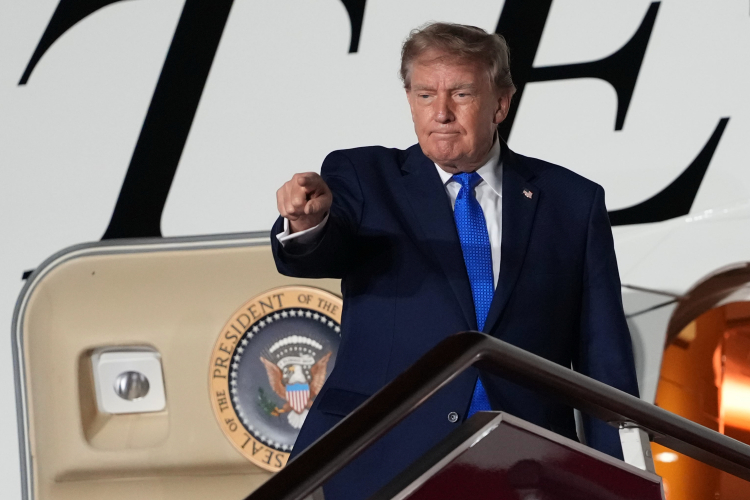
The easiest way to misunderstand President Trump’s Asia trip is to judge it solely by what happened during eighty minutes at a table with Xi Jinping and Vladimir Putin.
No Ukraine peace agreement emerged. Iran was not suddenly solved. China did not agree to slash its nuclear arsenal. The first-ever trilateral summit of the leaders of the United States, China and Russia produced a four-point declaration and broad commitments rather than an instant geopolitical breakthrough.
But that misses the board.
The more revealing way to view the trip is as a sequence: strengthen America’s economic and strategic position across the Indo-Pacific, deepen relationships with countries living under Chinese pressure, expand American energy and technology influence, and only then sit down with Beijing and Moscow.
Perimeter first. Talks second.
Start with the Philippines.
Washington and Manila announced a package combining commerce, defense, technology and infrastructure. Boeing and GE Aerospace finalized a $12 billion sale of up to 20 787s to Philippine Airlines. The two governments will pursue a loan package of more than $2 billion for American-made defense equipment. Separately, according to the White House, $400 million in U.S. military financing will pay for long-range fires, command and control, and drones for Philippine forces in the South China Sea.
At Subic Bay, a $40 million fuel storage depot will be built. Farther north, in the Philippine islands closest to Taiwan, Basco Airport will be modernized to improve operational access, disaster response and supply chains.
Geography makes these moves consequential. The Philippines sits along the First Island Chain and directly faces the South China Sea. Strengthening its infrastructure, military capabilities, communications and economic relationship with Washington therefore serves multiple purposes at once.
Then came Thailand, without Trump leaving Manila.
There, at the ASEAN summit, President Trump and Prime Minister Anutin Charnvirakul announced the substantial conclusion of a trade agreement designed to eliminate Thai tariffs on 99 percent of American goods while attacking non-tariff barriers affecting American autos, pharmaceuticals, medical devices, ethanol and poultry. The deal, Trump said, will “bring the United States and Thailand closer than ever before.”
Thailand also intends to commit up to $123 million to American HIMARS rocket systems, adding a security dimension to the commercial relationship.
Bangkok hedges. Four days earlier it signed economic and security documents with Beijing. That makes its choice of American rockets and American trade terms more telling, not less.
That combination illustrates an emerging model of American statecraft in Asia: market access, trade reciprocity, industrial sales and security cooperation reinforcing one another rather than operating in separate diplomatic silos.
The same pattern appears elsewhere.
In Indonesia, an American company is negotiating a $2 billion coal-technology project with the country’s sovereign wealth fund. Malaysia signed a three-year, $100 million contract for Montana coal, and an American consortium will build its government cloud. Brunei is moving toward a data-center buildout of nearly $1 billion sourced from U.S. vendors.
Energy is particularly important.
The United States enters this Asian competition with an advantage China, an energy importer, cannot match: the ability to supply energy at scale while simultaneously providing technology, capital equipment, aircraft, defense systems and access to the world’s largest consumer market.
That is economic power converted into strategic power.
President Trump made precisely this broader case at APEC. The United States, he said, has been “a Pacific power for hundreds of years.” The Pacific Rim, he noted, produces “more than 90% of all semiconductors.” He promoted American energy exports to Asia, citing the Alaska LNG pipeline. His argument was that America’s ability to remain a Pacific power ultimately rests not merely on naval deployments but on economic dynamism at home.
Investment. Energy. Technology. Manufacturing. Trade.
Those are instruments of foreign policy too.
Only after this regional groundwork did Trump sit down separately with Putin and Xi, and then with both in the three-way format he had proposed. “We are really making history,” he told them as the meeting opened.
The expectations surrounding that meeting were met with smiles but clear yes.
The United States, China and Russia disagree fundamentally over Ukraine, Iran, trade, technology, sanctions and the future structure of international power. No eighty-minute conversation was going to erase those conflicts.
Yet the meeting still raises an important strategic question.
Is engagement with adversaries a substitute for deterrence — or can it be one component of deterrence?
The Asia trip suggests the latter.
Trump did not arrive in China after withdrawing from the region. He arrived after strengthening relationships with governments across Southeast Asia, announcing American commercial deals, expanding defense cooperation, promoting American technology and energy, and reinforcing important geographic positions.
That changes the meaning of engagement.
There is an important difference between talking to a rival because one lacks alternatives and talking after strengthening one’s own position.
This is why the Manila agreements may ultimately matter more than the Shenzhen photograph.
They represent the less glamorous work of power accumulation.
China has manufacturing scale and a growing military. It also has neighbors who buy American weapons to guard against it. Russia retains nuclear power, natural resources and the ability to disrupt the international system.
The United States possesses something neither can match: a combination of market power, military alliances, technology, energy, capital and geographic partnerships.
The strategic task is to integrate those advantages.
That also means avoiding two opposite errors.
The first is believing that diplomacy alone can dissolve conflicting national interests. It cannot.
The second is believing that refusing to speak with adversaries somehow demonstrates strength. It does not.
Nuclear-armed governments have to compete, deter and communicate simultaneously.
The real test of the Shenzhen trilateral is therefore not the declaration it produced. It will be whether direct communication can eventually contribute to limiting nuclear risks, constraining escalation around Iran and Ukraine or ending the wars, and establishing clearer boundaries for competition.
Those outcomes will take time.
The image history may remember from this trip is Trump sitting at a circular table with Xi and Putin. But photographs are not strategy.
The strategy is the board surrounding the table: stronger Philippine capabilities, a Thai trade agreement nearing signature, American energy and technology becoming embedded in regional infrastructure, and an expanding network of countries with economic and security interests linked to the United States.
That is what makes the trip worth examining as a whole.
America is competing with China while talking to China. It is strengthening its position while leaving channels of communication open.
Perimeter first.
Talks second.
That is the board.