

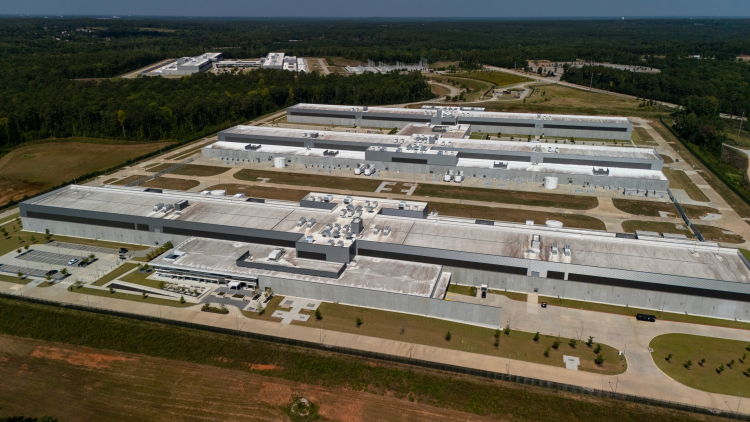
As demand for artificial intelligence accelerates, data center moratoria threaten to constrain computing capacity, driving up the cost of AI development and deployment and potentially limiting one of the most consequential sources of American economic growth.
The Economics of Compute
Computing costs encompass the capital and operating expenditures required to process, store, and transmit information. They include personal and enterprise hardware, cloud infrastructure, and AI-specific computation, including model training and inference. American companies are increasingly choosing to employ compute-for-hire, purchasing cloud-based storage systems instead of owning cumbersome, labor-intensive internal infrastructure. Their expenditures are consequently measured in GPU-hours and tokens processed.
We need not look far to see what these developments could mean for the economy as a whole.
Moore's Law has shown that the number of transistors on an integrated circuit doubles every two years at minimal cost. This, combined with advancements in hardware capabilities and software efficiency, has driven a steady decline in the cost of computational performance.
The cost of querying an AI model with performance comparable to GPT-3.5 fell more than 280-fold between November 2022 and October 2024. An OECD report documented a nearly 80% decline in quality-adjusted prices for cloud-accessed text AI models between January 2024 and April 2026.
Cheaper intelligence has continued to invite increasingly ambitious applications, generating new demand for computational capacity. As the economic viability of AI-enabled products expands, so does the incentive to embed artificial intelligence throughout commercial operations.
McKinsey’s yearly State of AI report finds that 44% of respondents report scaling AI across their enterprises. The progression from isolated, hesitant experimentation toward enterprise-wide integration suggests that demand for computational infrastructure will increasingly reflect recurring operational requirements as both benefits and costs become embedded in the modern, AI-centric business model.
Data centers represent the physical foundation of this burgeoning digital economy, combining processors, servers, storage, and networking into commercially accessible computational capacity. Expanding that capacity requires substantial upfront investment and long development timelines. Local moratoria, typically adopted to reconsider zoning rules and community impacts, can delay the addition of capacity and increase the marginal cost of computational services.
This phenomenon is both geographically expansive and agnostic. In 2026, the National Conference of State Legislatures identified 16 states considering data center moratorium measures which would pause or ban new development. The ALEA Institute, an organization dedicated to the advancement of legal and ethical AI, recorded 1,101 restrictive local data center-related actions within a broader infrastructure inventory spanning 47 states.
In cases where restrictions meaningfully constrain supply, these moratoria function as classical economic suppressors, weakening competition, slowing capacity expansion, and placing upward pressure on compute prices. Better models and more efficient chips are able to moderate those effects, but efficiency alone cannot guarantee abundant capacity when both prices and usage increase simultaneously.
Why Lower Costs Matter
Affordable computation is arguably one of the most important economic affairs of the 21st century — innovation generates prosperity only when its benefits spread beyond early adopters. Lower unit costs reduce the commercial threshold for deploying AI, allowing startups and smaller businesses to access capabilities previously available mainly to large enterprises. More firms can automate routine processes and accelerate discovery, while introducing products that would otherwise be prohibitively expensive.
The OECD estimates that AI could increase annual labor-productivity growth by 0.4–1.3 percentage points in highly exposed economies over a decade. Goldman Sachs estimates that widespread generative AI adoption could raise global GDP by approximately 7% — or a remarkable 7 trillion USD — over ten years. These benefits depend entirely on diffusion and access to competitively priced compute.
Conversely, persistently elevated computing costs can restrict adoption to enterprises capable of absorbing substantial technological expenditures, potentially reinforcing market concentration and limiting the diffusion of productivity gains.
Competitive compute prices therefore serve a function extending well beyond the profitability of technology companies; they influence the rate at which innovation becomes commercially accessible across the broader economy — across the broader American psyche.
The Cost of Restricting Capacity
As firms incorporate AI throughout production, restrictions on infrastructure may increasingly function as constraints on innovation across the wider economy. The central consideration being ignored — the proverbial elephant in the room — in the development of these moratoria is whether America can preserve the abundant, accessible, competitively priced computation necessary to translate technical progress into broadly shared prosperity.
The United States has an opportunity to translate advances in artificial intelligence into sustained productivity growth, greater industrial competitiveness, and improvements in household prosperity. Realizing those gains will require not only increasingly capable models, but also abundant, accessible, and competitively priced computational infrastructure.