


Balancing the State and the Market - 4/30/10
 | After decades of consensus that the state should set the rules and otherwise leave the private sector alone, the state is now widely seen as a beneficial force that should play an active role in the economy. This is happening despite the lack of a clear indication of the superiority of the state. More |
The Debate About Strategic Default - 4/28/10
 | A response to Luigi Zingales’s “The Menace of Strategic Default”—and a response to the response. More |
Teacher Pensions: Fiscal Time Bomb - 4/28/10
 | What could be worse news than that public school teacher pensions across the country report an unfunded liability of over $330 billion? How about the fact that these reports understate the size of the liability by a factor of three? |
An Entrepreneurial Middle East? - 4/27/10
 | The U.S. must work harder to foster an Arab middle class. More |
Attention Whole Foods Shoppers - 4/27/10
 | Stop obsessing about arugula. Your "sustainable" mantra -- organic, local, and slow -- is no recipe for saving the world's hungry millions. More |
The Goldman Gaffe - 4/27/10
 | Proof that the SEC doesn't understand the markets it regulates. More |
Scott Brown and Wall Street - 4/23/10
 | Senator Scott Brown won his seat partly because voters are angry about bank bailouts. Now he can show fellow Republicans that there’s a way to work with Democrats to protect the economy from Wall Street — not by expanding government, but by improving its rules. More |
Can Silicon Valley Save California? - 4/23/10
 | The world is full of pseudo-Silicon Valleys — private and public attempts to re-create California's high-tech mecca. But they have achieved only pale copies of an original that remains the undisputed cradle of innovation.But Silicon Valley faces a serious threat in the form of the fiscal and regulatory earthquakes that have put California on the verge of becoming a failed state. More |
Goldman: Who's Really at Fault? - 4/21/10
 | Unless the SEC is sitting on more evidence than it has laid out so far, the charge sheet looks flimsy. If Goldman has become a poster child for excessive power on Wall Street, the SEC might become a poster child for government power run amok. More |
Happy Earth Day! And Please, Live - 4/21/10
 | Rather than seeing the increased population as human ingenuity delaying death, doomsayers present charts and graphs highlighting potential catastrophe. Like cult leaders predicting that the world will end on a particular date, doomsayers look to the future with fear. You can extrapolate just about any trend into disaster, if you ignore reality. More |
Airline Fees: Where's the Free-Market Spirit? - 4/20/10
 | Washington does not “have an obligation’’ to second-guess the fees charged by Spirit or any other private business. Absent evidence of fraud, theft, or coercion, airlines should be able to charge what they think the market will bear, free of governmental meddling. More |
Spending Cuts Globally - 4/20/10
 | The received wisdom in the United States is that deep spending cuts are politically impossible. But a number of economically advanced countries, including Sweden, Finland, Canada and, most recently, Ireland, have cut their government budgets when needed. More |
The Eternal Life of Megabanks - 4/16/10
 | The world economy faces a major problem: the largest banks in the United States remain “too big to fail,” meaning that if one or more of them were in serious trouble, they would be saved by government action – because the consequences of inaction are just too scary. More |
Auditing the IRS - 4/16/10
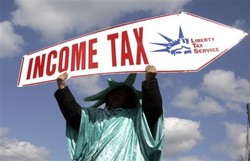 | If you struggled with some of the complicated new changes in your tax return this year, you’re not alone. The Internal Revenue Service also had problems. More |
How Soaking the Rich Clobbers Everyone - 4/16/10
 | Nearly half of American tax filers didn't have to pay any federal income tax last year. But Americans -- especially New Yorkers -- shouldn't enjoy the free ride. Soon enough, everybody will pay for the higher spending that Washington's "generosity" encourages. |
Illinois' Downward Spiral - 4/14/10
 | Illinois is in a downward spiral that, yes, still can be reversed. First, though, we have to admit that we are not the Illinois that was — the muscular producer and processor and manufacturer that could stare a stranger in the eye and convincingly boast More |
Should the IRS Fill Out Your Tax Return? - 4/13/10
 | Many other countries already use a system in which the government fills in many of points on an income tax return, like wages, standard deductions. The technology already exists to do it here. After all, credit card companies can process and track billions of transactions with remarkable accuracy.But others argue that many taxpayers would be better off sticking with commercial preparers who not only calculate taxes but... More |
Tax Planning for Coming Tax Hikes - 4/13/10
 | Buy munis, book losses, avoid marriage, consider a Roth conversion now and get your Lasik eye surgery next year. More |
Myths About China's Economy - 4/12/10
 | China's stunning economic rise is one of the biggest stories of this generation. In just three decades since beginning to embrace market economics, China has left its desperate poverty behind to become the world's top exporting nation. The transformation has occurred so quickly that myths and misperceptions abound about the challenges and opportunities that China poses to America and the rest of the world. More |
Why Regulators Can't Protect Us - 4/09/10
 | Here's my problem with the financial regulation package that Sen. Chris Dodd has proposed: It hands the very regulators who failed us in 2005 and 2006 and 2007 and 2008 the responsibility for saving us next time. More |
Can We Pay the Poor to be Successful? - 4/09/10
 | Ordinarily, markets set prices for true economic exchanges. But a new antipoverty program begun by New York City Mayor Michael Bloomberg in 2007 bestows cash rewards on (for the most part) single parents and their children if they act responsibly—by attending school, for example, or by working. More |
Can the Financial Industry Pay for its Own Bailout? - 4/08/10
 | As part of Washington's plan to fix Wall Street regulations, lawmakers, supported by President Obama, want financial firms, rather than taxpayers, to pay for future bailouts of their industry.Such a suggestion is impractical. In a future crisis, the financial industry would need more than $20 trillion up front to cover unknowable losses if it were to avoid turning to... More |
Your House's Value (Probably) Won't Rise - 4/07/10
 | It has been 10 months since prices stopped their free fall, and there is a lot to like in price stability — not only relative to prices crashes but also relative to price booms. For years, many American homeowners persuaded themselves that real housing prices should rise year in and year out, but there is no reason to either expect or hope for perpetual price gains. More |
No Time for a Trade War - 4/07/10
 | When the Great Recession began, many worried that protectionism would rear its ugly head. Then, 17 of the G-20’s members introduced protectionist measures just months after the first summit in November 2008. Continuing economic weakness in the advanced economies risks a new round of protectionism. More |
The Economy and the Knowledge Problem - 4/06/10
 | In his "The Use of Knowledge In Society," Hayek explained that information about supply and demand, scarcity and abundance, wants and needs exists in no single place in any economy.The economy is simply too large and complicated for such information to be gathered together. Any economic planner who attempts to do so will wind up hopelessly uninformed and behind the times, reacting to economic changes in a clumsy, too-late... More |
The Long View Offers Hope - 4/02/10
 | If all goes well in China and India in the next generation – and if nothing goes catastrophically wrong in the rich, post-industrial, North Atlantic core of the global economy – the next generation will reach a real milestone. For the first time, more than half of the world will have enough food not to be hungry, enough shelter not to be wet, enough clothing not to be cold, and enough medical care not to be worried... More |
When Cities Go Broke - 4/01/10
 | Cities across the nation should pay close attention to Vallejo’s workout plan. If bankruptcy isn’t a fix for past profligate spending on public employees, then more debt and higher taxes may be inevitable—a sobering thought in an already-struggling economy. More |