




When staring directly at the edge of a cliff, you quite naturally begin to explore all the ways in which you might avoid going over it. The closer you get, obviously the more urgent the inquiry. And that’s exactly where we find our collected selves yet again, with assurances from all the usual suspects to ignore our lying eyes because they’ll make sure everything will be just fine.
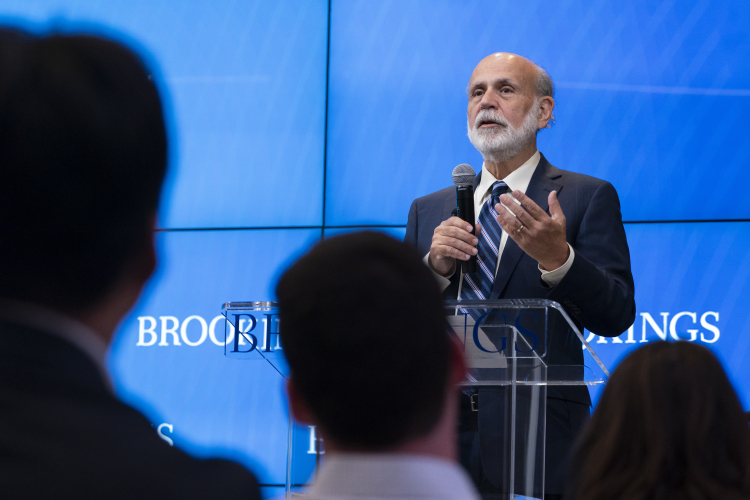
Such was the case twenty Novembers ago. A fellow by the name of Ben Bernanke, future Nobel Prize Winner (is there one for fiction?), stood up before a room filled with assembled (friendly) Economists and told them what they already knew – or thought they knew.
The US was facing some rather difficult circumstances in November 2002. Though the dot-com recession itself was mild and already nearly a year in the past by then, the recovery from it, what there was of one, was unusually lethargic as if any contractionary forces refused to abate. Worse, the dot-com bust in the stock market which had triggered the economic setback didn’t seem to want to end, either.
Adding to the palpable angst, Japan. Its experiences with the Lost Decade (first of four, and counting) were fresh, the D-word at first only whispered came to be more openly feared as stocks kept busting and the economic restoration kept being put off.
Any comparisons between the Japanese and anyone else – at that specific time - were made based on a whole lot of mistakes and ignorance, of course. The US nor anywhere outside of Japan had been in any danger of deflation because of what deflation truly is.
It is not what Ben Bernanke claimed back then, that’s for sure:
“The sources of deflation are not a mystery. Deflation is in almost all cases a side effect of a collapse of aggregate demand - a drop in spending so severe that producers must cut prices on an ongoing basis in order to find buyers.”
Everything which followed over the intervening twenty-plus years owes to this Keynesian nonsense, upon which is piled ever more.
Deflation – as none other than John Maynard himself wrote repeatedly – is a monetary disease, the other side from inflation. Where the latter is too much currency (chasing too few goods, as the saying goes), the former is when not enough causes an interruption in exchange which undercuts productive businesses who have to take drastic defensive (preserving liquidity) measures to avoid sinking into the abyss of insolvency (or worse, disappointing shareholders).
And as Mr. Keynes had pointed out, in that case it is the worker, the Little Guy who ultimately bears the brunt as he is unceremoniously often mercilessly sent to either the literal or figurative unemployment line.
Even the early Economist Henry George came to fully appreciate how business depression and deflation could not have been the sudden disappearance of demand. That, George wrote in 1894, was not his or anyone’s actual experience:
“On the contrary, seasons of business depression are seasons of bitter want on the part of large numbers, of want so intense and general that charity is called on to prevent actual starvation from need of things that manufacturers and merchants have to sell.”
Businesses have goods and consumers still want them, “aggregate demand” doesn’t change because what does is an interruption in the ability to act on it, “some impediment in the machinery of exchange” as Mr. George realized. The impediment would turn out (repeatedly) to be the very one Keynes would, among many others, identify a quarter-century later.
Why wouldn’t Mr. Bernanke have known this? Economists in the modern day don’t actually study money and monetary characteristics. In the absence of understanding and scholarship, they are forced to filter all thoughts, ideas, and theories through the realm of stochastic econometrics which can only emphasize economic rather than monetary aggregates at the expense of more useful knowledge and avenues of interpretation.
The closer any Economist is to the central bank, ironically the further from monetary facts they end up. Ben Bernanke is the absolute perfect example of this perverse effect.
In all such absence, what gets plugged into the equations is, Fed = money. In fact, this is the only part of Bernanke’s November 2002 speech anyone remembers.
“What has this got to do with monetary policy? Like gold, U.S. dollars have value only to the extent that they are strictly limited in supply. But the U.S. government has a technology, called a printing press (or, today, its electronic equivalent), that allows it to produce as many U.S. dollars as it wishes at essentially no cost.”
If that had been the case, then where did all the world’s money called dollars actually come from? They sure as hell didn’t originate off some digital Fed printing press.
The tens maybe hundreds of trillions (if we’re including derivatives, as we should) of so-called dollars already by then were of private bank origin, not creatures of public bureaucrats talking themselves up.
Talk, however, was precisely the guy’s point. As he would admit many years later, in 2015, by Bernanke’s own estimation “monetary” policy at the Fed consisted of 98% talk. The remainder, he said, was 2% action, though when you do the monetary math it always adds up to 100% bullshit (pardon my language).
Like Alan Greenspan’s famous 1996 “irrational exuberance” speech which hadn’t really been about exuberance or even stocks (it was really about how the Fed couldn’t track money in the real economy, all that private bank money, which meant no one there would have any idea if stocks were behaving irrationally or rationally), Mr. Bernanke’s 2002 homily wasn’t truly about the printing press, either.
Not an actual one, anyway. His real purpose came in the very next sentence following what’s quoted above:
“By increasing the number of U.S. dollars in circulation, or even by credibly threatening to do so, the U.S. government can also reduce the value of a dollar in terms of goods and services, which is equivalent to raising the prices in dollars of those goods and services.”
The whole ballgame is contained in that small, little-noticed qualifying clause tucked neatly into the middle in between the purposefully-placed technocratic noisiness: “credibly threatening to do so.”
Bernanke was not then nor is now unaware of where the vast majority of our money came from and still does. He very much understood the Fed’s contributions to the grease in the machinery of exchange were insignificant, to put it charitably. The “central bank’s” policies worked entirely on psychology, or moral suasion if you want to get fancy about it.
Should the Fed ever need to, it would “credibly threaten” to use a printing press to keep deflation from arising. If the ruse was successful, the banks would then create useful money (ledger eurodollars, not actual currency) on his behalf.
But how do you threaten to use something you don’t actually possess?
The only possible answer is to make damn sure no one discovers the truth.
Every conman and charlatan is eventually exposed when they are inevitably asked to prove their claims. That time wasn’t 2002 and 2003, the money globally (eurodollar) continued to flow uninterrupted. What had made the US part of the worldwide recovery so feeble was Ross Perot’s prediction of the “giant sucking sound” (financed by all those global bank dollars) coming true rather than legit deflation.
The moment of truth would arise only a few years further on when it turned out the excesses of so much private and global bank money proved to be, well, dangerously excessive. Suddenly in August 2007, deflation was no rumor.
Rather curiously, the Fed’s magic elixir right then underwent an overhaul. Back in ’02, Bernanke had claimed the Fed already in hand everything it would if we should ever find ourselves in a truly deflationary situation like Japan’s:
“Thus, I do not view the Japanese experience as evidence against the general conclusion that U.S. policymakers have the tools they need to prevent, and, if necessary, to cure a deflationary recession in the United States.”
Yet, in the deflationary situation of late 2007, what did the Fed do? It began inventing new tools! Out of nowhere, TAF and overseas dollar swaps. Those were joined in early 2008 with even more, one after another after another, a veritable alphabet soup of initialisms, all brand-spanking-new tools.
A crisis that “should” have been impossible instead spread all around the world and caused the world’s workforce an incalculable sum, a deficit we are still experiencing to this very day. You would be forgiven for wondering if the Fed’s tools weren’t all that effective, results which were no better than if offered by a gigantic and literal confidence scheme.
Here’s the thing, though. All these policy tools which had been introduced in response to the real monetary crisis around 2008 remained in the toolkit throughout the years following it if only to keep up the illusion. And during those years, one huge problem after another, many which looked surprisingly similar if on a lesser scale to what really happened originally.
Then March 2020.
Going into that affair, now-Chairman Jay Powell had at his disposal the same improved recipe for snake oil that Bernanke had cooked up; all the tools the latter had created were available to the former. And they didn’t work. Again.
Instead, shockingly, I know, the Fed came up with…more new tools. And it is these which Mr. Powell said recently we all should count on to cushion the blow should 2023 turn out to be as disastrous as is being priced all over the world’s legitimate money markets.
Inversions in Treasuries, eurodollar futures, Canadian or German governments, many of these are near or at historic even unprecedented levels. Not to worry, Powell reassured the public in early November, tools, tools, tools.
“Again, if we overtighten—and we don’t want to, we want to get this exactly right—but if we overtighten, then we have the ability with our tools, which are powerful, to, as we showed at the beginning of the pandemic episode, we can support economic activity strongly if that happens, if that’s necessary.”
“Which are powerful.” The blatant, non-random need to toss in that phrase in order to continue with the “credibly threatening.” If you have the all-powerful printing press as claimed, there would not be any need for all this other stuff.
Such stuff worked so well to “support economic activity” after March and April 2020, just like the aftermath of 2008 there’s another huge hole run through the jobs market (again workers suffer deflation; Keynes didn’t get much right, and much has been done so wrong following his prescriptions, but he definitely nailed that one). In just the US, employment remains millions (as many as six or more) behind where it would’ve been had there been a real recovery.
Blame the pandemic! Blame subprime mortgages! Buy more snake oil!
What if it all really is just a con? What would you do upon finding out? Any rational actor would hedge the ever-loving crap out of everything, finally understanding the difference therefore danger(s). That’s just what the entire global marketplace has done because it does recognize the truth, and has known from the beginning.
The hedging today is, frankly, beyond 2007-ish.
It all goes back to the lie about the printing press. Money comes from banks, not bureaucrats. And the banks are exactly who has inverted these curves, just who it is who is hedged for oblivion. You want to know why the Powells and Bernankes (and Dudleys) of the world tell you to ignore them?
Curves expose the fraud(s). And the oncoming cliff.
