




For decades, the case for restoring gold to its monetary role has been made with great intellectual seriousness and small political effect. Lewis Lehrman made it. Steve Forbes made it. Ron Paul built a political movement around it. Judy Shelton argued for it in books, articles, and eventually in a Senate confirmation hearing for the Federal Reserve, where she came within a single vote of joining the board. John Tamny has argued it consistently and well in these pages, channeling John Stuart Mill's observation that gold is the commodity "least influenced by any of the causes which produce fluctuations of value" — which is precisely why money defined by it earns the trust of those who use it. The intellectual case has never been stronger. The political results have been essentially zero.
Now consider the possibility that gold is being remonetized anyway — not through argument, not through legislation, not through a new Bretton Woods conference at Mar-a-Lago — but through the inadvertent actions of a president who can't quite decide whether gold is a serious monetary asset or a reality television prop.
The history of gold's long war with the economics establishment is worth reviewing briefly, because the current moment only makes sense against that backdrop.
John Maynard Keynes called gold a "barbarous relic" in 1924 and spent the next two decades trying to design it out of the international monetary system. He largely succeeded at Bretton Woods in 1944, where gold was retained as a nominal anchor — the dollar convertible at $35 an ounce — but more like a figurehead constitutional monarch than a King. Richard Nixon finished the job in 1971, closing the gold window and cutting the dollar's last formal link to the metal. The economics profession celebrated. Milton Friedman had long argued that disciplined central banks managing floating exchange rates were superior to the gold standard's rigidities. The debate, it seemed, was settled.
Gold's response was to rise from $35 an ounce to $850 in nine years. The 1970s, which were supposed to demonstrate the superiority of managed money, produced stagflation and a dollar that lost more than half its purchasing power. Investors who trusted the economists lost 87% of their real wealth. Those holding the barbarous relic quadrupled theirs. It was the most emphatic possible rebuttal — but the mainstream reaction was we just needed tougher monetary policy.
Paul Volcker crushed inflation with 20% interest rates, real yields turned positive, and gold collapsed from $850 to $255 by 1999. The gold standard advocates kept writing. Nobody in power kept listening. European central banks actively sold their reserves. The Bank of England liquidated 395 tons near the exact bottom of the market in 1999-2002 — a transaction the British press immortalized as "Brown's Bottom," after Chancellor Gordon Brown who ordered it — in what may stand as the single most expensive act of institutional contempt for gold in monetary history.
The gold standard's academic champions were not the only ones who remembered what gold is for. There is another constituency that never forgot — one that doesn't write papers or testify before Congress. They are the people who have had to think seriously about carrying their wealth across an unpoliced border at midnight. Refugees, dissidents, the citizens of countries where governments have confiscated, inflated, or simply stolen savings within living memory. For them, gold's monetary properties were never theoretical. A gold coin crosses borders that a bank account cannot. It is accepted in languages its owner doesn't speak, by people whose institutions its owner doesn't trust. The economics profession spent fifty years explaining why this was an anachronism. The people who needed to flee didn't have the luxury of agreeing.
The 21st century brought gold back through the 2008 financial crisis and quantitative easing, but still no restoration of monetary status. The advocates kept at it. Tamny argued in these pages as recently as March 2025 that a gold standard "would do wonders for economic growth." Shelton proposed that Trump issue a 50-year Treasury bond convertible into gold, timed for July 4, 2026 — America's 250th anniversary — as a statement of monetary intent. The intellectual machinery was ready. The political will was not.
Then something unexpected happened, and it didn't come from any of the gold standard's advocates.
It came from Vladimir Putin.
When the United States and its allies froze $300 billion in Russian central bank reserves in February 2022, they demonstrated something that every gold standard advocate had argued for decades but never proved in real time: that assets held in dollars or euros exist at the sufferance of the governments that issue those currencies. They can be frozen, seized, or made worthless by political decision. There is precisely one major reserve asset that cannot be confiscated by any government on earth, cannot be inflated away by someone else's monetary policy, and does not require trusting any institution. Central banks around the world received the message instantly.
Global central bank gold purchases hit a record 1,080 tonnes in 2022 — the highest since the gold standard era — and have remained at historically elevated levels since. The buyers are the countries that watched the Russian sanctions and did the math: China, India, Turkey, Poland, Singapore. For the first time since 1996, the world's central banks collectively hold more gold than U.S. government bonds. This is not the gold standard. But it is something the gold standard's advocates always predicted would happen if people understood what money is really for — and something that no amount of intellectual argument managed to achieve.
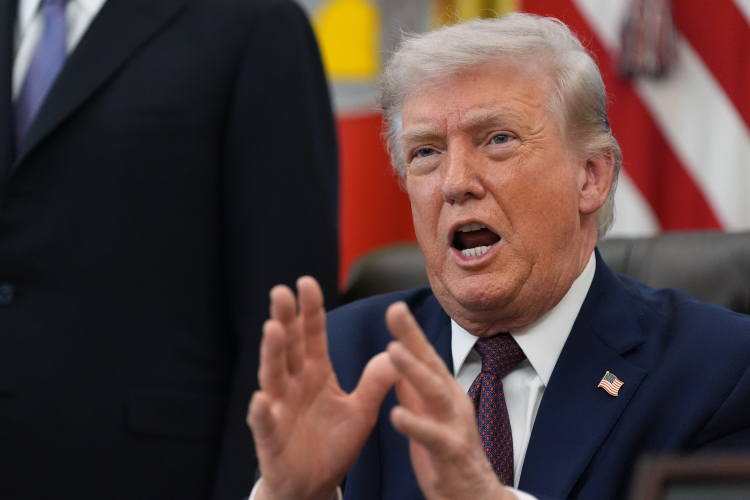
Now add Donald Trump.
Trump's relationship with gold has always been more aesthetic than philosophical. He puts it on his buildings, his interiors, his aircraft. He called the gold standard "wonderful" during his first term without apparently having read much Lehrman or Mises. His administration contains genuine gold standard thinkers — Shelton came within one Senate vote of joining the Fed; Scott Bessent casually mentioned wanting to "monetize the asset side of the U.S. balance sheet for the American people," a phrase that sent gold markets briefly haywire before he walked it back.
None of this is a coherent monetary policy. But coherence may not be what matters here. What matters is the direction of travel.
Trump's tariffs and trade war have weakened the dollar. His confrontational posture toward allies has raised questions about whether dollar assets are as politically neutral as reserve managers once assumed. The Iran war — which his administration launched in February 2026 — has closed the Strait of Hormuz, triggered the largest global oil supply disruption in history, and driven foreign central banks to sell $82 billion in Treasuries in five weeks as they scramble for dollars to defend their currencies and pay energy bills. The petrodollar recycling loop — Gulf oil revenues flowing back into U.S. government debt — has seized up as Gulf producers can't get their oil out.
In the middle of all this, gold is near $5,000 an ounce, within sight of its all-time high. It is not performing as an inflation hedge — that story has never been quite right, since only about 16% of gold's price movements correlate with inflation. It is performing as something more fundamental: the asset you hold when you have lost confidence in the institutions managing the alternatives. That is exactly the condition that Tamny, Shelton, Lehrman, Forbes, and Paul have been describing for decades. They were right about the diagnosis. What they didn't anticipate is that it would take a president who doesn't understand monetary economics to create the conditions that prove their point.
There is a kind of poetic justice in this. The gold standard's advocates spent fifty years trying to persuade central bankers, treasury secretaries, and economists. They lost every debate in the official arena. Then a politician came along who, through tariffs, sanctions, debt, dollar weakness, and a war that disrupted the world's most important energy chokepoint, manufactured in fourteen months the exact set of conditions under which gold spontaneously re-monetizes — not by decree, not by Bretton Woods, not by a gold-convertible bond issued on the Fourth of July, but because sovereign institutions around the world looked at the available options and quietly started buying.
Gold doesn't need legislation. It needs distrust. And that, whatever else one might say about the current moment in American governance, is not in short supply.
It is worth noting that gold is not the only asset making this argument. Bitcoin was invented in 2008 — precisely when trust in financial institutions last collapsed — with the explicit design of creating a monetary asset immune to government debasement: fixed in supply, beyond the reach of any central bank, seizure-proof by design. It is, in a sense, the technological acknowledgment that the gold standard advocates were right about the problem. The appeal of virtual gold is understandable. So is the appeal of an AI girlfriend. Neither is quite the real thing. Bitcoin has so far failed to achieve what gold has: sovereign adoption. No central bank in Warsaw, Beijing, Mumbai, or Ankara is adding it to reserves in meaningful size. The institutions doing the buying still want something they can hold in a vault, with five thousand years of references.
Whether Trump finishes the job — whether some version of the Mar-a-Lago Accord, a gold-linked bond, a revaluation of the statutory price of U.S. reserves, or simply the continued erosion of dollar confidence tips the world toward something resembling a gold anchor — remains genuinely uncertain. Trump is not a monetary theorist. He is not even a consistent advocate. Earlier this year he and Elon Musk demanded a Fort Knox audit as a spectacle before Bessent assured everyone the gold was there and the subject was quietly dropped.
But the gold standard's advocates have always understood something that its critics missed: monetary systems don't change because of arguments. They change because reality forces the question. For the first time in half a century, reality is doing the advocates' work for them.
John Tamny has been right about this for a long time. He may be about to be proved right in a way he never expected.
