




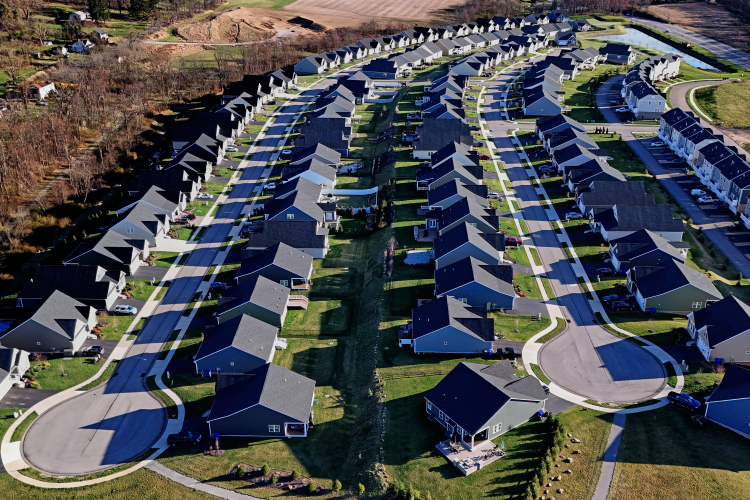
The YIMBY movement is at a crossroads. On the one hand, 2026 is poised to be a banner year for small-lot housing legislation, with 25 state legislatures considering bills with total or partial alignment with AEI Housing Center Playbooks. The YIMBY movement has quickly learned how to frame the issue: move reforms up to the state level, simplify rules, and build broad cross-partisan coalitions that treat housing abundance as pro-family and pro-opportunity, not a cultural statement.
On the other hand, the politics of housing supply remain difficult. President Trump has expressed concern about policies that might drive housing prices down – a poor outcome for homeowners. This gives pro-homes advocates a tricky needle to thread: how do we build more homes and increase affordability, without triggering fears of a housing market crash or political backlash?
As to the first point, it would be difficult for a few hundred thousand extra starter homes per year to instigate a crash in a market with 85 million homes. Consider Houston, one of the nation's largest and most affordable cities. Houston metro area has seen home prices appreciate by 132% since 2012, as compared to 150% nationally and 176%, 192%, and 224% for Los Angeles, Atlanta, and Phoenix respectively. It adopted small-lot policies applicable to a large area around its downtown in 1998 and expanded citywide in 2013. The result was the construction of 80,000 small-lot homes since 2010, with Goldilocks results: prices neither declining nor rising too fast.
Regarding backlash, some in the YIMBY movement “suggest a focus on building apartment buildings in urban settings near transit stops while avoiding new developments in single-family neighborhoods, which are sometimes viewed as politically untouchable”, adding “those will be able to house way more people than single-family homes, and they will make a bigger dent in the affordability crisis.”
That framing may be politically easier, but focusing only on apartments ignores what Americans actually want and underdelivers for working families. The vast majority of Americans (86%) want to live in single-family homes.
The affordability story also looks different when we focus on low-income workers aged 25-65 years . Overall, over 70% of these workers live in single-family 1-4 homes. Only 9% of those in rental housing are in buildings with 50+ units. Bottom line: we need more single-family 1-4 homes, because that is where Americans want to live, and where low-income workers do live.
When the conversation stays at the level of “density” or “units,” it often misses the constraint that shows up in real family life: bedrooms. Large rental buildings built since 2010 average 1.4 bedrooms, while single-family homes average 3.5. As to cost: nationally, the median gross rent for a three-bedroom home is only 24% higher than for a one-bedroom apartment. In other words, families pay a modest premium for roughly triple the bedrooms, which is one reason single-family homes are the backbone of workforce housing for families who double up, share costs, and need space. Any solution that ignores adding to single-family supply will fail to meet the needs and wants of the American people, and will fail to address affordability for home ownership.
The key strategic shift is to center the type of home that unites Americans across political lines: family-sized starter homes.
Small-lot housing policies can address both supply and affordability as they recognize that land and construction costs are the two main drivers of supply scarcity and unaffordability. The solution is more affordable homes built on smaller lots. Yes, these homes will sell for less, but because they cost less to build, not because they will drive down the price of the existing housing stock. Moreover, these policies will greatly add to supply. Think of it in terms of building more small cars. That would expand the market for small cars but would have little impact on the price of a Mercedes.
By building family-sized starter homes on smaller lots, we can provide the naturally affordable housing that families want and solve our housing supply shortage, without driving down the price of the existing housing stock.
