




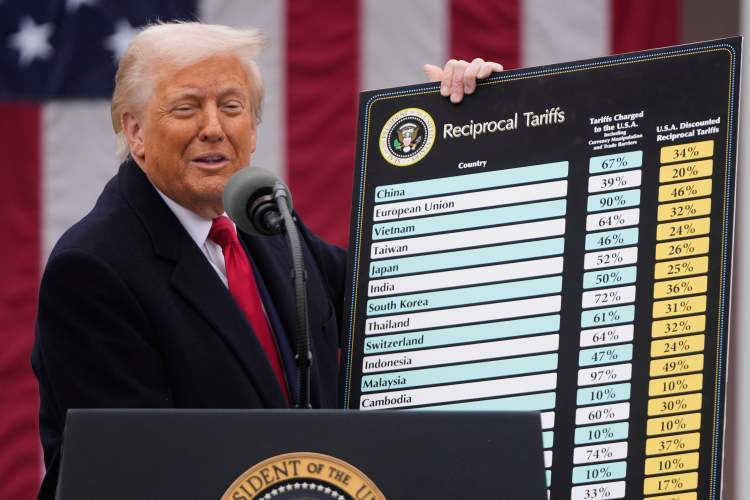
Matthew Lynn opens his one-year anniversary of Liberation Day piece by noting that nobody organized a party. “As birthdays go,” he writes, “it was a very quiet affair.” Evidently he finds this odd, but there is a really easy explanation: you don’t throw a party when there’s nothing to celebrate. Deep down, even the most ardent tariff supporters understand what the evidence over the past year has shown. Manufacturers have shed jobs, all citing tariffs. Consumer prices continue to rise above the Fed’s 2% target. Trading partners are cutting deals with each other and deliberately circumventing America. The quiet is the sound of a policy whose own champions can’t quite bring themselves to cheer too loudly.
For the third time, Lynn has declared that economists owe tariff supporters an apology, that the doomsayers have been thoroughly rebuffed, and that the “Trump Trade Order, as Lynn calls it, is only the beginning of the greatness that is to come. I responded to similar claims made by him in October and again in December. One would hope that a third wouldn’t be necessary, but here we are.
Let’s start with where Lynn and I actually agree. The American economy is incredibly resilient. The reason for this is simple: the American worker is incredibly resilient. They are, on a per-capita basis, the most productive people on the planet, bar none. The fact that they have absorbed the tariff fiasco of the last year is a testament to them, not the policy.
Economists Were Wrong? Still?
Lynn has accused economists of being wrong six months, eight months, and now twelve months post-Liberation Day. His original complaint was that Goldman Sachs and Paul Krugman called for a likely recession. In my previous responses to this contention, I pointed out that those predictions hadn’t expired at the time of Lynn’s writing and that both had revised their recession probabilities downward in response to the President repeatedly walking back his tariffs through delays, exemptions, and carveouts. The conditional predictions of economists Lynn points to were made in April, 2025, when we were assured that there would be no exemptions, not even for farmers, to the Liberation Day tariffs. That assurance lasted a whopping six days. In light of the President “chickening out,” Goldman Sachs and others revised their recession predictions.
But let’s be fair. As the great sage Yogi Berra once told us, “it’s tough to make predictions, especially about the future.” That’s why we’ve forgiven Mr. Lynn for his 2007 prediction that the iPhone would be “nothing more than a luxury bauble that will appeal to a few gadget freaks,” that “the big competitors in the mobile phone industry such as Nokia and Motorola won't be whispering nervously into their clamshells over a new threat to their business,” and for confidently telling people that “it is too early to start dumping your Nokia shares.”
The TTO’s Flagship Wins Deserve Scrutiny
One of his more ambitious claims is that the rest of the world has quietly accepted the Trump Trade Order and reorganized around it. He names a list of concessions: the EU dropped tariffs on automobiles, Japan opened its rice markets, South Korea committed to $350 billion in US investment, and more. As he writes, “None of those are minor tweaks. They have induced a fundamental shift in trading relationships, a shift that previous administrations spent decades trying and yet failing to achieve.”
First, he has a very interesting definition of “quiet.” I seem to recall a flurry of foreign leaders chastising Trump for this on day one. And Canadian Prime Minister Mark Carney giving a rousing speech at Davos that received thunderous applause. And a certain commercial that aired during the MLB’s World Series that caused quite the storm in the White House. And when the EU halted trade negotiations over Trump’s push to acquire Greenland. Some might call that “quiet,” but others might disagree.
But even if we set all of this aside, there’s a crucial piece of evidence that Lynn neglects to share. The fact of the matter is that Americans paid for these concessions. We paid with tens of thousands of manufacturing jobs lost since Liberation Day. We paid with rising prices as tariff pass-through rates rose through 2025, something the President himself admitted by acknowledging the veracity of the Harvard Business School’s study.
Second, Lynn argues that the TTO is a win for blue-collar workers, shifting the balance away from Wall Street and toward the factory floor. He quotes Marine Le Pen, who argues that “Globalization means using slaves to manufacture products that are then sold to the unemployed,” and writes that “her rhetoric may be inflammatory, but it’s hard to deny that there’s a kernel of truth to her observation.”
It’s a vivid line, but its conclusion is exactly wrong.
Put yourself in the shoes of the factory workers that Lynn claims to be championing. Since Liberation Day, what have they seen? Manufacturing employment falls and factories are shuttering their doors. Those assuaged by the President’s remarks that “jobs and factories will come roaring back into our country” are now faced with the reality that as construction spending on manufacturing continues to decline, those jobs and factories don’t seem to be anywhere on the horizon.
This isn’t a difficult thing to imagine. President Trump is far from the first president to use tariffs with this goal in mind. President Bush did it in 2002, Obama in 2009, Trump in 2018, and Biden did it in 2024. In each case, the short term gains to the protected industries were more than offset by the losses to downstream industries feeling the pressures of higher costs for materials. This makes sense: you don’t help manufacturers by making it more expensive to manufacture.
The “Resilience” Argument is Just Paying More for Less
Finally, Lynn celebrates the TTO for shortening supply chains and making our economy more robust. He points out that “your local Walmart was stocked with products from the farthest-flung corners of the world” and that this was “intensely fragile,” requiring only a “minor disruption somewhere along the chain to crash the whole system.”
And what is the “minor disruption” that he uses to illustrate this point? COVID.
Let "minor" sink in for a minute. That same disruption which caused policymakers to shutdown schools for two years, locked people in their homes, idled entire industries by government decree, and led to the largest peacetime expansion of federal spending in history is “minor.” The supply chain chaos observed from 2020-2022 was not caused by excessively long supply chains that exposed us to unnecessary risk. It was caused by abject policy failure, driven by political choices that cascaded through an economy that governments around the world had deliberately frozen. If that’s what Lynn considers “minor,” I cannot begin to imagine what a “major” disruption would be. The lesson from COVID is not that supply chains are fragile because they’re too long. It’s that governments are too quick to overreact. Shortening supply chains does not fix that problem.
One Year In
To his credit, Lynn does close by acknowledging that “we are not going to go back to a 1950s world when most production was domestic.” He admits that the tariff rollout was chaotic, that “Lesotho was probably not such a threat to American jobs that it warranted a 50 percent rate,” and that fighting a war with Iran while also trying to reorganize global trade probably complicated both. These are major concessions and he should be commended for making them. He’s admitted that the tariff policy was essentially made up on the fly and poorly sequenced from a geopolitical standpoint. But in doing so, he’s essentially arguing that the policy was good, but rough around the edges.
At some point, though, the rough edges are the policy.
One year in, manufacturing employment is down, prices for American consumers and producers are up, and the tariffs are being borne almost exclusively by Americans in one form or another. Trading partners around the world who haven’t cut deals with us (and some who have) have deepened ties with one another and are increasingly cutting us out. The Trump Trade Order, as Lynn calls it, has reorganized global trade, but not necessarily in the way that Lynn’s victory lap would suggest.
America deserves better than this. We deserve lower barriers, access to raw materials and inputs that we can use in our advanced manufacturing industry, and trading partners who are not just willing to trade with us, but excited to do so. The tariff vindication that Lynn has been promising across three separate articles now remains as elusive as ever.
