




An Upper East Side bar is hedging a free-drinks promotion on a prediction market. The exchange calls it a milestone. The algebra calls it a 37%-off sale with extra steps. Kalshi thinks this is what society wants from it.
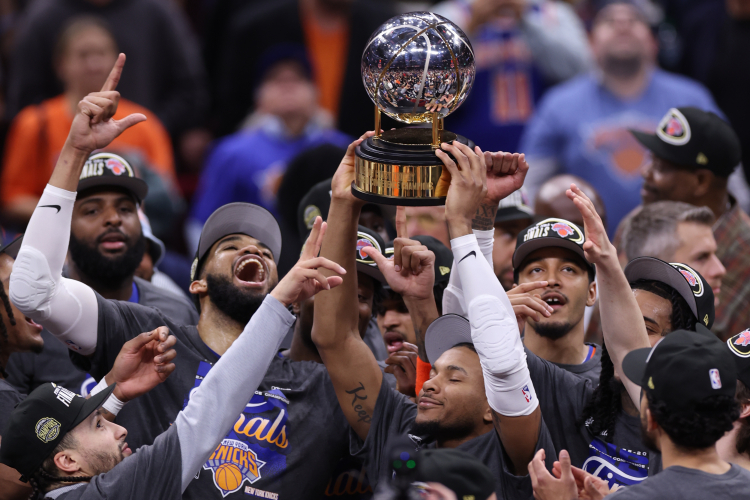
The pitch landed in my inbox with the breathless tone reserved for genuine firsts. The Jeffrey, a bar on the Upper East Side, will comp every tab on Wednesday night if the Knicks win Game 1 of the Finals. To protect itself against a Knicks victory — and the resulting wall of unpaid bar tabs — the bar is buying contracts on Kalshi that pay off precisely when the Knicks win. Kalshi is thrilled. This, we are told, is the first small business in history to hedge event risk on a prediction market, and surely the first of many.
Let me say up front that I like prediction markets. They are a genuinely good technology for two things: aggregating scattered information into a single probability, and letting people lay off risks that are large, correlated with their livelihood, and otherwise nondiversifiable. A festival promoter hedging a hurricane. A farmer hedging a freeze. These are real problems that a liquid market on a well-defined event can actually solve.
A bar comping drinks if the Knicks win is not one of those problems. It is a coupon. Let me show you the algebra, because it is short and it is funny.
The free tab is a price cut in a trench coat
Let p be the probability the Knicks win Game 1, and call it 37% for concreteness based on current Kalshi prices. A patron deciding whether to order another Negroni faces a simple expected price. With probability p the drink is free; with probability (1 − p) she pays the menu price X. Her expected cost per drink is therefore (1 − p) × X = 0.63X.
“Free if the Knicks win” is, in expectation, just 37% off. Every drink on the menu is now quietly on sale, and people respond to sales the way they always do — by buying more. A drinker orders until the pleasure of the next drink is worth its price. Drop that price from X to 0.63X and she keeps going: from some sensible quantity q up to a larger q+Y.
Here is the trouble with Y. Those marginal drinks are, by definition, ones she would not have bought at the real price. Society still spent the full X to pour them — the gin, the labor, the rent — while she values them at less than X. The gap is pure waste, the little Harberger triangle every economics student draws, except this one is filled with tequila. If the Knicks lose she pays it—along with the costs the fourth drink doesn’t put on the tab: the hangover, the argument, the cab, the sidewalk. Those were already a reason to drink a bit less than q. The promotion pushes hard in the other direction.
If the Knicks lose the bar also pays because it loses its Kalshi bets. If the Knicks win the aggregate loss is the same, but the bar has used Kalshi to push them on other people. This is something for Kalshi to boast about?
So before anyone touches a prediction market, the structure has already engineered a night of over-ordering, paid for partly in deadweight loss and partly in other people’s mornings. The “gift” consists largely of drinks nobody would buy sober, sold to people whom the promotion is explicitly designed to keep from being sober.
But it gets worse, much worse. If the Knicks pull ahead in the fourth quarter and p climbs toward one, the expected price of the next round falls toward zero — which means the bar should be overrun with mathematically literate patrons slamming top-shelf shots at the final buzzer. I’m not sure this is the consumer-welfare triumph the press release imagines.
Now let the customers take the other side
Here is the part that should make Kalshi blush. The bar is buying “Knicks win” contracts for p. Somebody has to sell them for (1 – p). Suppose the patrons themselves do — each one selling enough contracts to cover her own tab T. The sum of all patron’s T is the bar’s hedge, B. The patron pays (1 – p) × T the bar pays p × B.
Now walk through both states of the world.
If the Knicks win: the tab is free, each patron loses (1 – p) × T, so pays 63% of her full-price tab. The bar collects B in Kalshi winning, but must subtract the p × B paid for the contracts, so nets (1 – p) × T, the same as the patron pays.
If the Knicks lose: the patron pays the full tab T, plus the (1 – p) × T for Kalshi contracts, But wins T. Net, she pays (1 – p) × T, the same as if the Knicks win. The bar collects the full B in tabs, but is out p × B paid for the contracts, so nets (1 – p) × T.
The lottery has vanished. What’s left is an ordinary, riskless 37%-off sale.
Which the bar could have simply offered. Tape a 37%-off coupon to the menu and you reproduce the entire outcome — same discount, same certainty — without anyone opening a brokerage account, posting margin against a basketball game, or computing the correct contract notional between cocktails. The only difference between the coupon and the prediction-market cathedral built to imitate it is the fees. Kalshi takes a cut on every contract, so the elaborate version is strictly worse than the coupon by exactly the exchange’s rake. In the great tradition of casinos, the house is the one sure winner, and the house’s edge turns out to be the entire innovation.
The risk it didn’t have to take
There’s a final irony worth savoring. The risk the bar is so proudly hedging did not exist until the bar created it by announcing the promotion. Kalshi is selling insurance against a danger its own marketing manufactured — the post office offering you insurance against it losing your package. And it’s a small, idiosyncratic, eminently bearable risk to begin with. A bar’s revenue already swings with the weather, the subway, and whether it rains on a Tuesday. One night’s tabs riding on one basketball game is exactly the sort of diversifiable noise a going concern is built to absorb, not the kind of existential, correlated risk that justifies paying a market-maker to take it away.
Prediction markets earn their keep when they tell us something we didn’t know, or carry a risk we genuinely can’t. The Jeffrey’s promotion does neither. It is a discount dressed as a derivative, a coupon with a toll booth, a 30%-off sale routed through Wall Street so a slice can be skimmed on the way to the bar. Drink to that, if you must — but maybe settle your own tab first.
