




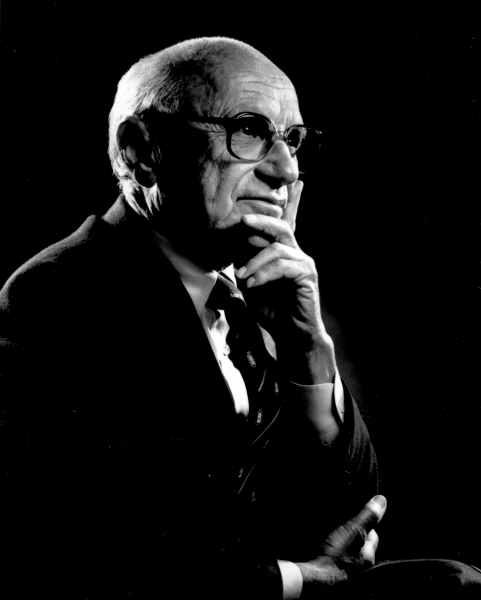
Milton Friedman was sometimes wrong. Revered by right and many on the left, a look back reveals thoughts and actions that were sometimes puzzling.
Take the work Friedman did at the U.S. Treasury during WWII. Historical accounts indicate that he was one of the economists who helped design tax-withholding. Considering Friedman’s correct stance that government spending is a tax, he seemingly didn’t embrace his association with a system that substantially enhanced the federal government’s ability to penalize work.
Then there’s his stance on money. How Friedman got money so wrong will always remain a mystery.
That’s because production itself implies money. Think about it. The sole purpose of production is to attain commensurate market goods in return, while money is an agreement about value among producers that facilitates their exchange. Which means money obviously predated the economists who tried to hijack the market phenomenon, including Friedman.
Even though prices of market goods are a staggeringly sophisticated effect of infinite decisions and actions of billions of people and machines around the world every millisecond, Friedman remarkably reduced the so-called "price level" to a monetary equation, M x V = P x Y. As Cato Institute co-founder Ed Crane used to say about equations and human action (economics), once the equations enter the discussion you know they're full of it.
Friedman’s conceit on the matter of prices and money was stunning. How could a free-market oriented thinker imagine that an effect of production (money) required planning by economists, at which point how could this same free market thinker ascribe to himself and other economists an ability to plan the quantity of exchange media?
Friedman ultimately admitted in 2003 that monetarism was bogus, but he wasn’t strident enough as evidenced by the monetarist religion rearing its ugly head yet again among Friedman’s disciples. History was clear as logic is clear that production cannot be planned, so to pretend that exchange media moving the production can be planned is a big stain not just on economics (there are many), but on Friedman’s proud legacy.
Lastly, there’s Friedman’s line about how “you can’t have free immigration and a welfare state.” The bet here is that if he were still around, this is the statement he would most like to retrieve.
Not only has it been perverted in such a way that Friedman’s free thinking is sadly associated with restriction of the migration of desperate people for something better, it’s that Friedman’s happy, optimistic warrior reputation is being associated with such a skeptical, unhappy, anti-human way of thinking.
Really, what human would pay enormous sums to “coyotes” for brutal passage to the United States, or walk endless miles in searing heat and cold to get to the United States without help, all for meager welfare offerings that aren’t even available to immigrants as is? What human would be willing to die in some of the cruelest ways just to attain welfare? Worse for Friedman, analysis that didn’t sound anything like him has yet again been hijacked by some of the most disagreeable aspects of the U.S. policy debate.
It would have been more Friedman-sounding to say that “you can’t have the booming economic growth that has long defined the United States without ambitious people of all stripes trying to cross the border to participate in it.” Yes, Friedman-ite optimism embracing a basic truth that people want better, most want much better than a welfare check or free anything, and opportunity within the United States has been making it possible for strivers to fix their poverty for centuries.
So there you go. There’s the speculation about what Friedman would have most liked to take back, his immigration line most of all.
