

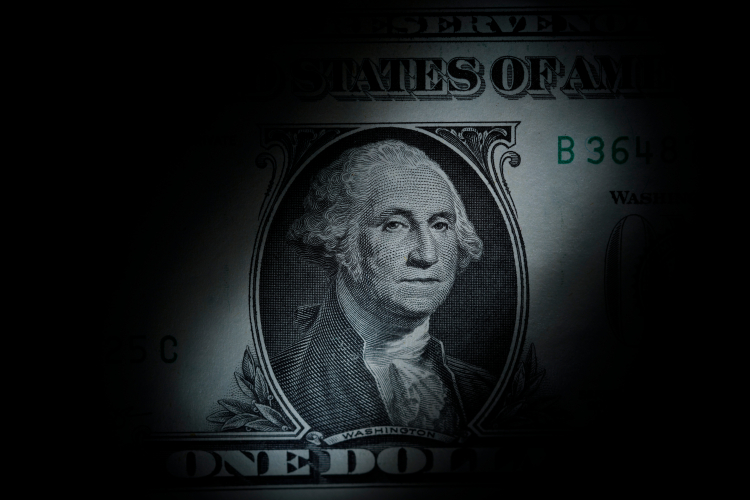
History looks us in the eye and quietly asks, “Have I taught you nothing?”
All money is nothing more than a medium of exchange. It is used to get stuff. That’s it. To be effective, it needs to be stable and a medium that others accept for voluntary transactions. Stable means that it holds its agreed-upon value.
Throughout history, the most stable forms of money have been gold and silver. During our British colonial history, the British pound sterling was the favored monetary standard, as it was widely accepted and generally reliable in holding its value. However, there was not much liquidity, i.e., British pounds floating around. Our creative and industrious colonial forefathers developed other mediums of exchange.
Spanish pieces of eight, which flowed into the colonies through trade with the Caribbean and Spanish America, were often used as money, even though transactions were based on and recorded in pounds sterling. As overseas trade was fairly one-sided under the British mercantilist system, much specie left the colonies to pay for British manufactured goods.
Yet our forefathers were creative. In Virginia, tobacco was used as money in a rather ingenious way. A hogshead delivered to a public warehouse could be used to issue a tobacco note. The note could be traded; thus, Virginia had created a commodity-backed payment system. The commodity was not gold or silver, but tobacco was the next best thing. One need only drive through Tidewater Virginia today and see the many baronial pre-Revolutionary homes built off the tobacco trade to grasp how enterprising men can create non-fiat “money.”
Another system was as old as history itself: credit. In England, there were banks and much more liquidity. Thus, a London factor could buy goods that a colonist wanted and then extend credit, to be repaid when the colonist shipped his goods to the factory. Then the ledgers were reconciled.
There was also private money. As a boy, I remember my Aunt Betty giving me a Fluvanna County, Virginia, gold piece, supposedly dating from the 1780s. Like a dumbass, I quickly lost it.
Much wealth was created during this early era, but the system was not perfect. For example, George Washington hated the British factors, as the colonists were totally at their mercy and repeatedly got screwed.
The system needed to be fixed, and Alexander Hamilton’s program of public credit and fiscal reform helped commercial activity prosper. The Bank of the United States, while serving a useful purpose, also created challenges and bad blood between the Federalists and Jeffersonian Republicans, and later between the Whigs and Jacksonian Democrats.
Whenever there are great concentrations of wealth bestowed by the government, there will be fraud, corruption, and political favoritism. Money extracted from levies gets deposited into the bank, and the bank lends money to friends, uses its resources for political purposes (loans to newspaper editors), and keeps sloppy books because, heck, it’s free money.
Bank notes were generally redeemable in specie. Fractional-reserve banking existed then, as now, and of course, this caused abuses.
Andrew Jackson vetoed the rechartering of the Second Bank of the United States in 1832, and a system was subsequently adopted in which federal money flowed into a myriad of state banks. Better to spread the wealth than have it concentrated in the hands of a small Northeastern oligarchy tied to Whig crony capitalism.
I’m a James K. Polk fan. Undoubtedly, he had a portal into the future and read my Rob Is Right articles, because HE GOT IT!
Polk was a gold-and-silver man, and under his advocacy, the Independent Treasury Act of 1846 was passed. The federal government would hold and collect its money in specie. No more government favoritism. This system of sound money lasted until the Federal Reserve was created, and the last sub-treasury closed in 1921.
Polk was born in a log cabin in North Carolina. FDR was born in a Gilded Age mansion and went to Harvard. Polk was smarter than FDR. The elite always think they are smarter than the yokels, but in reality, they are often clueless.
In 1933 and 1934, FDR and his pointy-headed sophists dismantled our monetary standards. In 1933, gold clauses in contracts were invalidated. He then made it generally illegal to own monetary gold and required Americans, subject to certain exceptions, to surrender their gold to the government at $20.67 an ounce, thus forcing them to trade an appreciating asset for depreciating paper money.
Finally, after he “stole” the gold from his countrymen, he fixed the price at $35 an ounce.
This foolhardy skulduggery devalued the dollar by approximately 41%, since each dollar represented less physical gold. It was a giant confiscation of wealth and a violation of constitutionally protected property rights, a “red” transfer of wealth from creditors and savers to debtors, and an assault on confidence in the government and its duty to protect the currency.
Had FDR grown up splitting rails instead of prancing around in a sailor suit, playing croquet on the lawn of his family’s Hyde Park mansion, he probably would have known that all economic growth emanates from the supply of capital and that a stable currency is essential to productive investment.
Our next historic fiscal folly occurred in 1971, when Richard Nixon decoupled the dollar from gold. The United States had become like one of those failing banks that had lent out too much money and did not have enough specie to cover a run. Too many dollars relative to its existing gold reserves.
Nixon’s decision removed the last international gold constraint on monetary expansion. Before the unlinking, the United States had to consider whether its monetary policies would exhaust its gold reserves. The government reneged on its guaranteed promise to back the dollar with gold, thus undermining faith in the government and its currency.
The price of gold has increased from the official $35 an ounce in 1971 to approximately $4,000 an ounce today, representing a 99.1% devaluation of the dollar relative to gold.
As far back as 1813, the Sage of Monticello foresaw and warned us all about the dangers of currency devaluation, i.e., paper money. In a letter to his relative John Wayles Eppes, Jefferson stated:
“He who lent his money to the public or to an individual ... when wheat was well sold at a dollar the bushel, and receives now his nominal sum when it sells at two dollars, is cheated of half his fortune.”
In another letter to Eppes, dated November 6, 1813, Jefferson declared:
“Specie is the most perfect medium, because it will preserve its own level.”
Jefferson explained that precious metals possessed intrinsic and internationally recognized value, making them preferable to paper money susceptible to excessive issuance.
It is amazing that, with all the lessons of history, we lose our way.
For money to be effective and to efficiently propel commercial activity, it needs to be backed by something of value and immediately redeemable.
Governments will always bend the rules. Political favors, corruption, fraud, hubris, carelessness, etc. Moreover, whenever there is an implied indemnity, those to be indemnified will act imprudently. If you are going to be bailed out, why act responsibly?
For much of the 19th century, bank notes drawn on private banks (not federal currency) constituted much of commercial exchange. Private money may be making a comeback. Cryptocurrencies, tokenized gold and other assets, and blockchain-based payment systems could eventually challenge the government's dominance over money itself. After centuries of politicians manipulating the currency, technology may finally give citizens a means of exchanging and preserving wealth beyond the government's monetary machinery. Markets, not politicians, may ultimately determine which forms of money survive.
The first principle that history teaches us is that governments ignore the lessons of history.