




Treasury Secretary Scott Bessent’s recent attempts to influence the Yen and Treasury markets - attempts to keep a lid on long term Treasury yields - haven’t exactly gone to plan, at least so far. Bond and FX trading desks appear to have taken the brief market movements he inspired as good entry points to go back to doing what they were doing before he decided to step in, namely selling Yen and Treasuries.
Bessent was supposed to be the market savvy member of Trump’s economic team. He was so well qualified the MAGA crowd was able to overlook his past association with their nemesis, George Soros. He was a trader who understood markets, not some sneering ivory tower academic. If you needed someone the market would respect, this guy looked like he was straight out of central casting.
The markets apparently didn’t read his bio.
The Myth of the "Great Macro Trader"
Ah, yes, the Scott Bessent resume.
His reputation largely rests on his association with the legendary 1992 bet against the British pound, when Soros “broke the Bank of England”. The Bessent legend that emerged after his nomination is that it was a young Bessent who initially pitched the short Sterling idea to Stanley Druckenmiller.
Now, maybe that is how it happened but it sure isn’t the story we heard for years and years. And it even contradicts Bessent himself, whose perspective on the trade was profiled in “More Money than God” and also cited in “Inside the House of Money” where he noted that:
Make no mistake about it, shorting the pound was Stan Druckenmiller’s idea. Soros’s contribution was pushing him to take a gigantic position.
It was Soros who made the trade legendary. In Jack Schwager’s “The New Market Wizards” Druckenmiller summarized what he learned from Soros:
Soros has taught me that when you have tremendous conviction on a trade, you have to go for the jugular.
In a speech he gave in 2015 at the Lost Tree Club in Palm Beach, Druckenmiller related the conversation he had with Soros about the size of the short pound trade:
He looked at me with great disdain…He said, ‘That is the most ridiculous use of money management I’ve ever heard. What you describe is an incredible one-way bet. We should be 200% of our net worth in this trade, not 100%.
In other words, Bessent was in the room but it was Druckenmiller and Soros who outwitted the Bank of England. Getting hired by Soros back then was impressive by itself but you can’t get Druckenmiller or Soros level market skills through osmosis.
And one need look no further than Bessent’s own track record to confirm that he didn’t learn much. Bessent’s hedge fund Key Square Group, launched in 2015 with a $2 billion investment from Soros (even market legends make mistakes), lost money in five of seven years and closed when assets fell to about $500 million.
Bessent’s great macro trader legend is a myth.
A Masterclass in Spitting in the Wind
Bessent seems to think global capital markets can be pushed around with a few tactical orders and a headline. The results have been almost embarrassing:
- The Yen Intervention: Deploying a tiny $5–10 billion slice of the Exchange Stabilization Fund (ESF) to buy Yen in a market that trades over $1 trillion a day is a waste of capital; Soros would not approve. The market absorbed it, laughed, and went back to selling the yen once the headline faded.
- The "Doubled" Buyback: With long-term Treasury yields grinding toward 20-year highs, Treasury announced it was doubling off-the-run bond buybacks to $4 billion per operation. In a $31.5 trillion Treasury market, $4 billion is like spitting in the wind. In a hurricane. Yields erased the initial drop and spiked right back up the very next day.
Fighting His Own Administration's Trade Policy
Currencies across Asia—from the Indian Rupee to the Indonesian Rupiah to the Yen —are steadily devaluing against the dollar which is exactly what the textbooks say should happen when tariffs are imposed. The currency of a country targeted with tariffs will depreciate to absorb the tax.
So while the administration imposes aggressive tariffs to penalize foreign producers, market forces naturally push those foreign currencies down to balance trade flows. When Bessent steps in to buy yen or shore up foreign exchange markets, he is actively spending taxpayer funds to fight his own administration’s trade policy. He is panicking about the exact currency volatility that his boss's tariff agenda creates.
The "Most Interventionist” Treasury Secretary In Decades
Bloomberg recently dubbed Bessent the "most interventionist Treasury chief in decades," pointing to his habit of tweaking debt management schedules and, now, intervening in FX markets. And the interventionist label fits so much of the Trump economic agenda; Republicans are no longer the party of free markets. Indeed, there doesn’t appear to be much political support for free markets in either political party, but I digress.
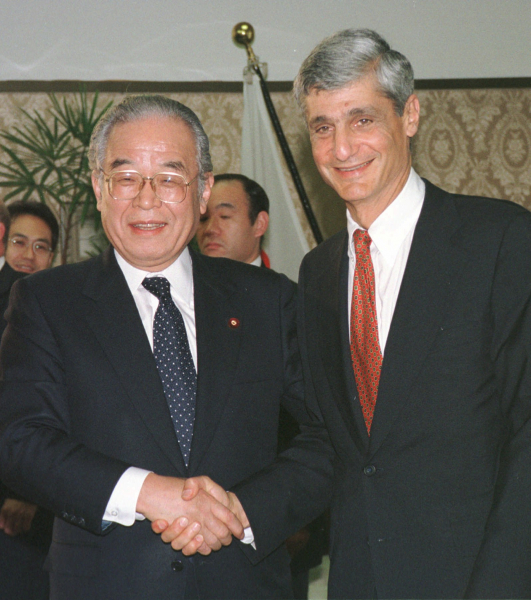
If you look back a few decades for an interventionist Treasury Secretary you find Robert Rubin of the Clinton administration, who never missed a chance to say “strong dollar”. But in one specific case, he violated that strong dollar mantra. Rubin famously bought Yen for dollars in the summer of ’98 at the behest of Timothy Geithner and Larry Summers who were worried about the developing Asian crisis.
Rubin had been saying for months that intervening without deep structural reforms to the Japanese banking system would have zero lasting effect. And he was right. The Yen popped after he swapped $800 million for Yen but when Japan didn’t enact any reforms, the market went right back to dumping Yen. It wasn’t until four months later, when Japan finally enacted bank reform legislation, that the Yen started to strengthen.
Rubin knew what Bessent apparently doesn’t - market interventions only work when you have structural changes as a tailwind. We aren’t seeing those types of reforms today. Japan still hasn’t normalized monetary policy, the Trump administration continues to impose new tariffs (Canada over the weekend) and the US budget deficit hit a new monthly record in July of nearly a half trillion dollars.
Bessent is certainly interventionist but he can’t please his boss and the market too. If he wants the Yen to rise for more than a day or two or bond yields to stop rising, something has to change. And so far, all he’s doing is trying to deny reality, saying recently:
We believe that the yields don’t reflect the underlying fundamentals.
That’s, of course, possible. Identifying when markets are mispriced is how alpha - outperformance - gets generated. But given his track record I’d be careful betting that Bessent has spotted such an anomaly in the Yen and Treasuries today.
